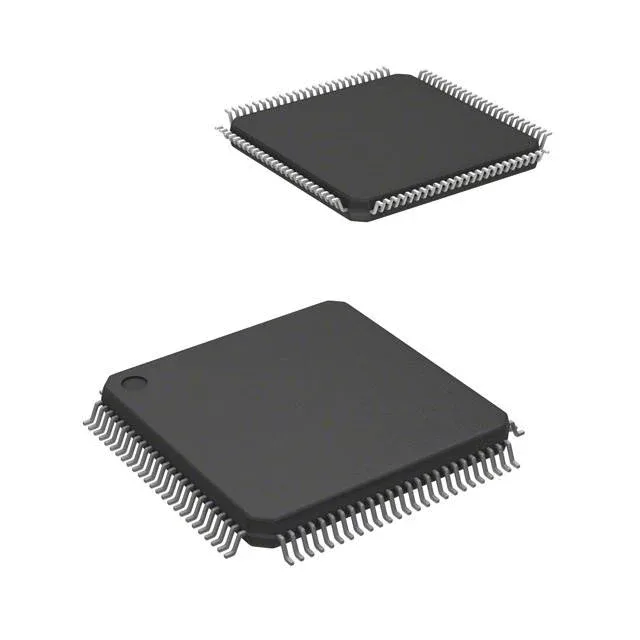
What this Cortex-M3 brings to the board
It is built for industrial control, motor drive, and human-machine interface applications where a mix of real-time control and connectivity is needed — the peripheral set includes CAN, USB OTG, multiple UART/SPI/I²C channels, and a QEI for quadrature encoder inputs.
Memory and peripheral fit
512 KB of on-chip Flash (512K x 8) paired with 64 KB SRAM (64K x 8) gives enough headroom for a modest RTOS, a TCP/IP stack, and a control loop without external memory. The 16-channel 12-bit ADC samples at rates suitable for motor current sensing or multi-channel sensor acquisition. On the connectivity side, the USB OTG port handles device/host/OTG roles, while the CAN 2.0B controller and full set of serial interfaces (UART, SPI, I²C, SSI, Microwire, IrDA, LIN) cover most industrial fieldbus and debug link requirements.
Industrial temperature range and operating conditions
The supply voltage window is 3.0 V to 3.6 V, matching a standard 3.3 V rail with margin for ripple. Internal oscillator is available, though an external crystal or clock source can be used for tighter timing accuracy.
Any new-design win should look at TI's current Cortex-M4 or M7 families, though a pin-for-pin drop-in does not exist; a board respin will be required.
Sourcing posture
Buyers filling a BOM line for an existing production board should expect to work with broker or excess inventory sources; the window for last-time-buy orders from TI has closed.