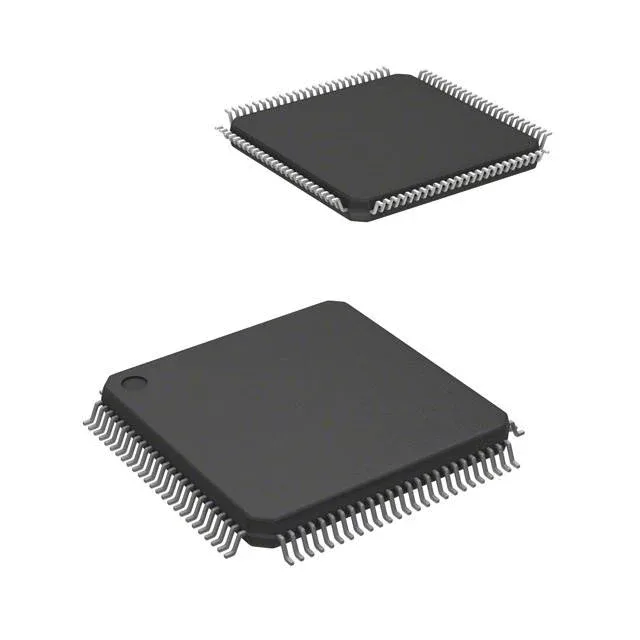
80 MHz Cortex-M3 with USB OTG, CAN, and LIN — the peripheral mix for industrial gateways
The LM3S5B91-IQC80-C1 is a Stellaris ARM Cortex-M3S 5000 series 32-bit single-core MCU clocked at 80 MHz, built around the ARM Cortex-M3 core. It packs 256 KB of Flash and 96 KB of SRAM, with 72 general-purpose I/Os distributed across a 100-pin LQFP package.
256 KB Flash / 96 KB SRAM — what the memory budget buys you
256 KB of Flash gives enough room for a full CANopen or Modbus stack plus a USB device/host firmware image, with headroom for OTA update staging if you partition for a dual-bank scheme. The 96 KB SRAM is notably large for this MCU tier — it can hold several 10-bit ADC scan buffers (the ADC has 16 channels at 10-bit resolution) and a sizable protocol data buffer without needing external SRAM. If your application streams audio over I²S or runs a graphical UI on a small display, that RAM headroom avoids cache-line management gymnastics.
For a production BOM that currently uses this part, the only reliable forward channel is the independent distribution market — last-time-buy inventory, surplus stock, and broker-sourced material. Any new design should consider a pin-compatible alternative in the Stellaris family if one exists, or a migration to a current TI Cortex-M4F or M7 part with similar peripheral mapping.
USB OTG and CAN — connectivity that matters in retrofit and panel applications
The USB OTG port lets the MCU act as either a USB host (flash drive, keyboard) or a device (virtual COM port, mass storage class). This is useful for field-upgrade scenarios where a technician plugs in a USB stick with a firmware image. The EBI/EMI interface on the connectivity list means it can also talk to parallel-memory peripherals or external FPGAs over a shared bus.