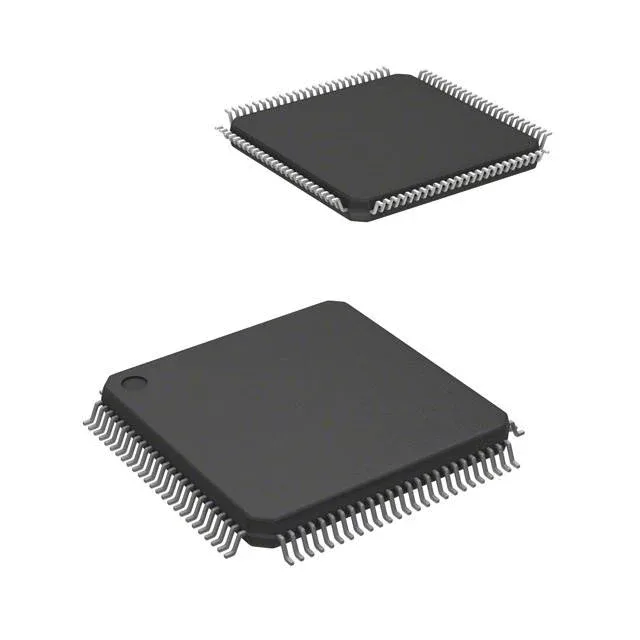
80 MHz Cortex-M3 with 256 KB Flash — what this MCU brings
This part targets control and connectivity applications that need a mature, well-documented Cortex-M3 core with a broad peripheral set. The 80 MHz core delivers single-cycle multiply and a 12-cycle interrupt latency, making it a solid fit for motor-control loops, real-time sensor fusion, and protocol bridging where deterministic response matters. The 256 KB Flash gives room for a full RTOS, a TCP/IP stack, and application code without external memory, while the 96 KB SRAM handles multiple packet buffers or a modest data-logging queue.
Peripheral set — CAN, USB OTG, and serial interfaces
The LM3S5B91 packs a CAN 2.0 controller, a USB OTG (On-The-Go) interface with PHY, and LIN support alongside the usual SPI, I²C, UART, and SSI. It also includes a QEI (Quadrature Encoder Interface) for direct motor position feedback and an IrDA encoder/decoder. This peripheral mix suits it for industrial gateways, automotive body controllers, and human-machine interfaces that need to talk over multiple bus standards without external transceivers (except the CAN/LIN PHY). The 72 general-purpose I/O pins, brown-out detect, POR, PWM timers, and a watchdog timer round out the control-oriented feature set. An internal oscillator keeps the core running without an external crystal, though an external clock can be used for tighter accuracy.
The Stellaris family was acquired by TI from Luminary Micro and later superseded by the Tiva C Series, but there is no direct pin-compatible drop-in replacement listed in the official records.
Design-in note — supply voltage and decoupling
The core supply range of 1.08 V to 1.32 V is tighter than the typical 3.3 V MCU rail — this part needs a dedicated 1.2 V LDO or switcher, not a direct tap off the 3.3 V bus. Decoupling with a 0.1 µF ceramic per supply pin pair is recommended, plus a 4.7 µF bulk cap on the 1.2 V rail.