Stellaris Cortex-M3 core at 50 MHz — control-loop ceiling
The LM3S5652-IQR50-A0T: That 50 MHz sets the throughput ceiling for the main control loop or protocol stack — enough for motor-control feedback, CAN gateway bridging, or USB OTG host negotiation without a dedicated co-processor. On-chip memory is 128 KB of flash and 32 KB of SRAM (organized as 32K x 8). The flash holds the application binary and bootloader; the 32 KB SRAM leaves room for a moderate RTOS heap and stack — budget the HAL and middleware footprint before committing the BOM. Supply voltage is 2.25 V to 2.75 V, which means a dedicated 2.5 V rail — the MCU does not run from the common 3.3 V supply. Plan a separate LDO or a dual-output regulator if the board already carries 3.3 V.
Industrial temperature grade and peripheral set
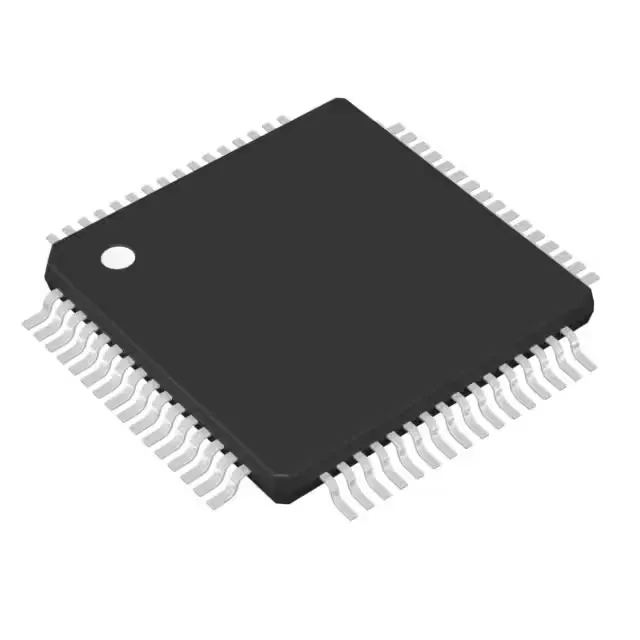
Connectivity covers CANbus, I²C, IrDA, Microwire, SPI, SSI, UART/USART, and USB OTG — a broad set for industrial fieldbus bridging and peripheral expansion. The six-channel 10-bit ADC handles basic analog sensing (potentiometers, thermistors, current shunts) but is not intended for high-resolution acquisition. On-chip peripherals include brown-out detect, POR, DMA, PWM, and watchdog — these reduce external supervisor and timer IC count on the board. The internal oscillator means the MCU can start without an external crystal, though the accuracy is limited to the internal trim. The 64-LQFP package (10x10 mm body) with 33 GPIOs — most pins are multipurpose; the peripheral mux must be checked against the required function set before the PCB layout is finalized.
NRND — sourcing posture for existing BOM lines
Texas Instruments lists the LM3S5652-IQR50-A0T as NRND (Not Recommended for New Designs). This means TI will continue to support existing designs but does not target this part for new projects. For a BOM that already carries this MCU, sourcing is through existing inventory or independent distribution channels.