Cortex-M3 at 50 MHz — what the core brings to the board
The LM3S5632-IQR50-A0: On-chip memory: 128 KB of flash (128K x 8) and 32 KB of SRAM (32K x 8). The flash holds a moderate firmware stack; the SRAM leaves room for a RTOS heap and a few packet buffers. No external memory interface — the design lives within these limits.
Peripheral mix — CAN, USB, and serial in a 64-pin package
Connectivity includes CANbus, USB, I²C, SPI, SSI, UART/USART, IrDA, and Microwire — enough to talk to a motor drive over CAN, log data over USB, and poll sensors over SPI in one design. The 33 GPIOs share the 64-LQFP pins with these peripherals; check the pin mux before committing the schematic. A 6-channel 10-bit ADC is on-die, plus a PWM unit and a watchdog timer. The DMA engine moves data between peripherals and memory without CPU cycles — useful for streaming ADC readings into a buffer while the core handles the control loop.
Package and rework — 64-LQFP, 10x10 mm, exposed pad
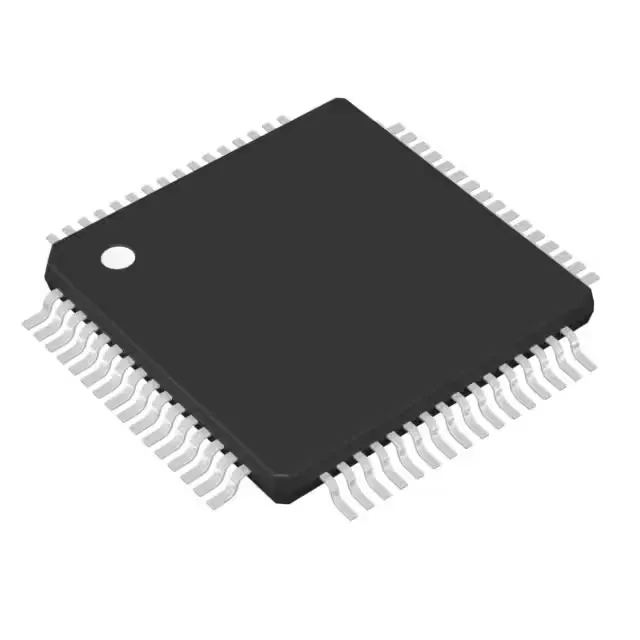
That's a hand-solderable footprint under a microscope — the exposed thermal pad on the bottom needs a good solder joint to the board ground pour for heat sinking. The pin 1 chamfer is clear; orientation is unambiguous under a hot-air station.
Lifecycle reality — NRND, still orderable
For a repair or a production run on an existing board, the LM3S5632-IQR50-A0 remains orderable. New designs should look at the current Stellaris or TM4C family for a pin-compatible path.