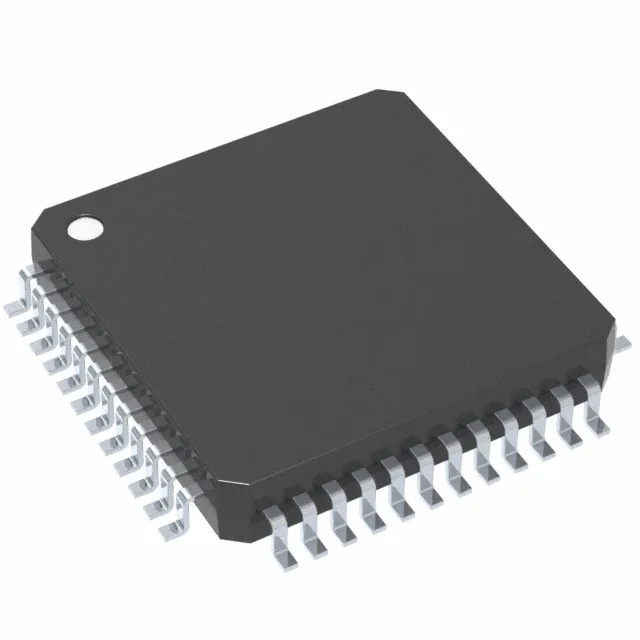
48-LQFP footprint and board-fit
The LM3S328-IQN25-C2T comes in a 48-LQFP package with a 7x7 mm body. That 0.5 mm pitch demands a controlled-impedance stack-up if any of the I²C or SPI lines run at full speed across a long trace — the 25 MHz core clock doesn't stress the layout, but the edge rates on the GPIOs can couple into adjacent signals if the return path is broken under the package. The internal oscillator means you can skip an external crystal for the core clock, but the UART/USART baud-rate accuracy depends on the internal RC tolerance — budget a ±2 % frequency error across temperature.
NRND — what it means for a BOM line
Texas Instruments lists the LM3S328-IQN25-C2T as NRND (Not Recommended for New Designs). That means the part is still orderable for existing production runs, but TI will not qualify it for new sockets — no new datasheet revisions, no extended temperature grades, no additional package variants. For a board already in production, the NRND flag is a supply-chain signal: the last-time-buy window could open at any time. The 48-LQFP footprint is common across the Stellaris 300 series, so a pin-compatible migration to a higher-memory sibling is possible without a board spin — but the exact replacement depends on the firmware memory map and peripheral set.
Industrial temperature and supply rails
The brown-out detect and POR reset the core if the supply dips below the threshold, so an external supervisor is optional unless you need a precise reset voltage or a manual reset button. The 8-channel 10-bit ADC samples at the rate set by the ADC clock derived from the 25 MHz system clock. The internal oscillator drives the ADC clock; if you need better than 10-bit accuracy at the full sample rate, an external reference on the VREF pin improves the INL. The 4 KB SRAM is enough for a small RTOS or a bare-metal state machine — the stack and heap must fit within that, so watch the linker script.