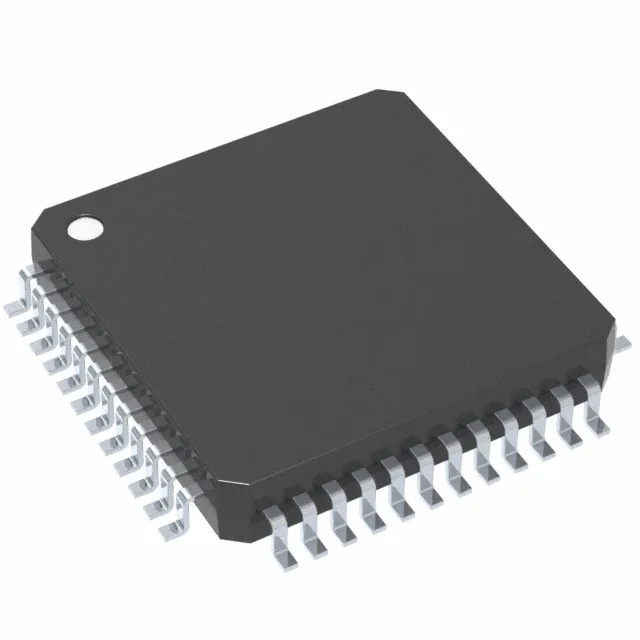
What this Cortex-M3 brings to a 48-pin LQFP
With 16 KB of Flash (16K x 8), the firmware budget is tight: a bare-metal control loop with a UART command parser fits, but a full RTOS with TCP/IP stack will push the limit. The 4 KB SRAM (4K x 8) handles a couple of moderate-size buffers for I²C or SPI transactions, but double-buffering a 1 KB ADC capture eats half the RAM. If your application needs over-the-air update staging or a large lookup table, step up to the higher-density siblings in the Stellaris family.
The supply range is 3.0 V to 3.6 V, so a regulated 3.3 V rail is the natural fit; don't plan on running it from a wide-input LDO or a battery that sags below 3.0 V.
Peripherals and connectivity for a control-oriented MCU
The peripheral set covers the essentials: brown-out detect and POR for reliable power-up sequencing, a PWM module for motor or LED drive, and a watchdog timer for system supervision. Serial connectivity includes I²C, SPI (via SSI), and UART/USART — enough to talk to an external ADC, an EEPROM, or a radio module. The 4-channel 10-bit ADC is there for basic analog sensing (potentiometer, thermistor, current shunt), though the 10-bit resolution limits precision measurement.
The base product number is LM3S316, which covers the whole family of speed and temperature variants.