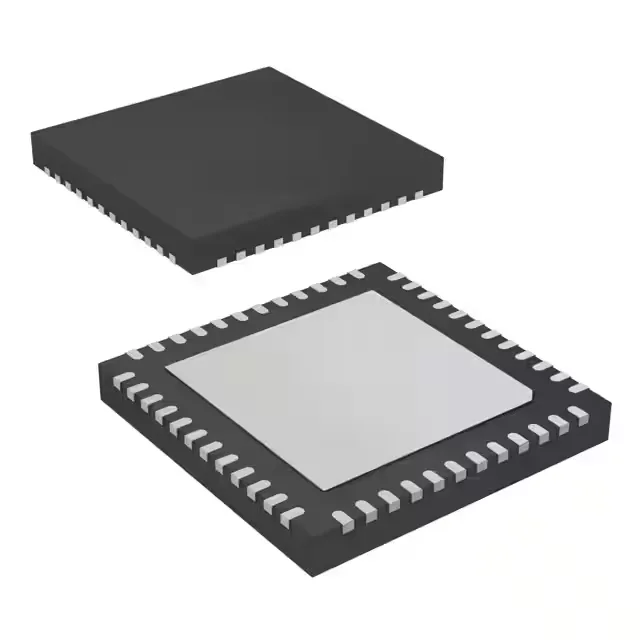
What this Cortex-M3 brings to a control board
The LM3S316-IGZ25-C2T: That core delivers the deterministic interrupt response and Thumb-2 instruction density that make it a natural fit for real-time control loops — think motor commutation timing, sensor fusion polling, or protocol bridging between a UART peripheral and an I²C sensor bus. The 32 general-purpose I/O pins give enough headroom for a parallel LCD interface, a row-column keypad, and a handful of discrete status LEDs without needing an external GPIO expander.
Package, temperature, and board-fit realities
The operating temperature range of -40 to 85°C covers most industrial enclosures, outdoor telecom cabinets, and engine-bay-adjacent electronics that see ambient heat soak but not direct exhaust. Supply voltage spans 3.0 to 3.6 V, so it runs comfortably off a 3.3 V rail — common in mixed-signal boards where the same rail powers the ADC reference and the sensor bridge.
On-chip peripherals for a lean BOM
The 4-channel 10-bit ADC samples at rates adequate for slow-moving analog signals — thermistor inputs, potentiometer feedback, or battery voltage monitoring. The PWM output, combined with the brown-out detect and watchdog timer, forms a basic safety watchdog for a motor drive or heater controller: if the firmware hangs, the WDT resets the core and the PWM outputs go to a safe state. Serial connectivity includes I²C, SPI (via SSI), Microwire, and UART/USART — enough to talk to a standard set of peripherals: an I²C temperature sensor, an SPI flash for data logging, and a UART-to-USB bridge for debug output. The Microwire compatibility is a legacy bonus if the BOM carries an older EEPROM or ADC that uses that protocol.
Lifecycle and sourcing posture
That means it is still a valid choice for new designs and existing BOM lines alike, with no forced migration pressure.