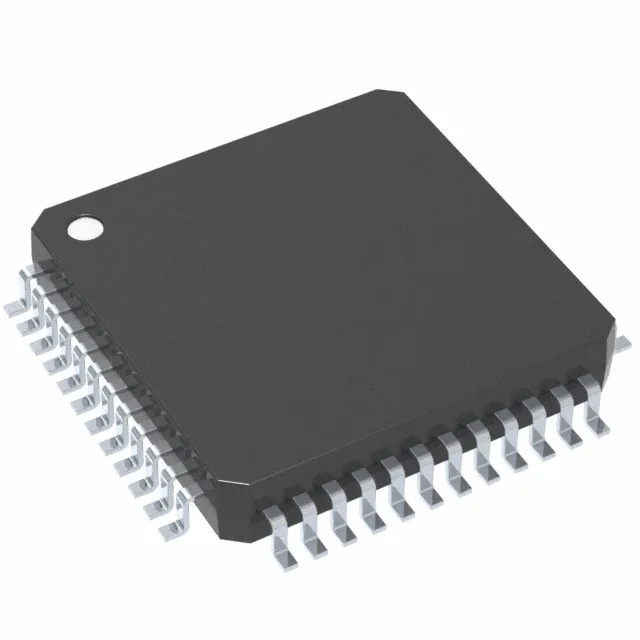
Cortex-M3 at 25 MHz — what the speed means for the BOM line
The LM3S310-EQN25-C2T: That clock rate sets the ceiling for control-loop bandwidth and protocol throughput — a PID loop sampling at 10 kHz with a 100 µs compute budget leaves margin for the stack and UART handling. The flash holds a modest firmware image — a sensor-node bootloader plus application code fits; a full TCP/IP stack with a web server does not. The 4 KB RAM (4K x 8) supports a few hundred bytes of heap and stack, enough for a Modbus RTU slave or a simple state machine.
Industrial temperature grade and on-chip supervision
Built-in brown-out detect, power-on reset, and watchdog timer reduce the external supervisor IC count. For a cost-sensitive two-layer board, these peripherals eliminate a dedicated reset generator and a voltage monitor — the MCU handles its own start-up sequencing.
Housed in a 48-LQFP with a 7x7 mm body and 0.50 mm pitch. The 36 I/O lines break out to the outer rows of the quad flat pack — a 4-layer board with ground and power planes is recommended for full fan-out. The internal oscillator eliminates an external crystal for basic clocking, though an external source can be fed through the SSI or UART pins if tighter timing is needed.
Sourcing reality — obsolete, no direct replacement
Texas Instruments lists this part as obsolete. No official successor or pin-compatible replacement is recorded.