NRND — sourcing through independent channels
Texas Instruments lists the LM3S308-EQN25-C2 as NRND (Not Recommended for New Designs). This means the part is not intended for new product introductions, but existing designs can still be supported through independent distribution. For a BOM already qualified on this Stellaris ARM Cortex-M3 MCU, the NRND status does not force an immediate redesign — but it does mean the supply window is finite.
Core and memory — what the 25 MHz and 16 KB flash mean for fit
The 32-bit ARM Cortex-M3 core runs at 25 MHz, delivering enough throughput for real-time control loops, sensor fusion, and protocol bridging without the overhead of a full MPU. The 16 KB on-chip flash (16K x 8) and 4 KB SRAM (4K x 8) suit firmware footprints for motor control, human-machine interface panels, or industrial sensor nodes — not data-logging or GUI-heavy applications. With 28 general-purpose I/O lines and an 8-channel 10-bit ADC, the LM3S308-EQN25-C2 can handle a mix of digital inputs, PWM outputs, and analog sensing on a single chip. Connectivity options include I²C, SPI, SSI, Microwire, and UART/USART — enough to interface with common serial peripherals, memory devices, and host controllers. The brown-out detect, POR, and watchdog timer provide basic system supervision without an external supervisor IC.
Package and temperature grade
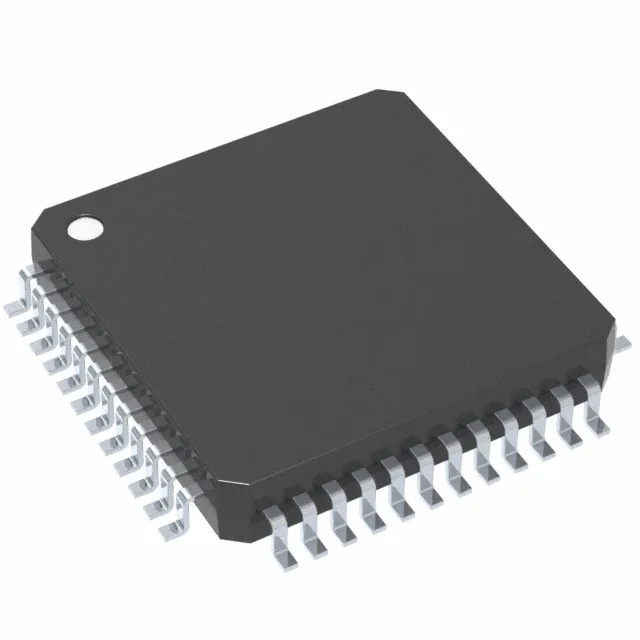
Housed in a 48-LQFP (7x7 mm) surface-mount package, the LM3S308-EQN25-C2 fits on compact PCBs with standard reflow profiles.