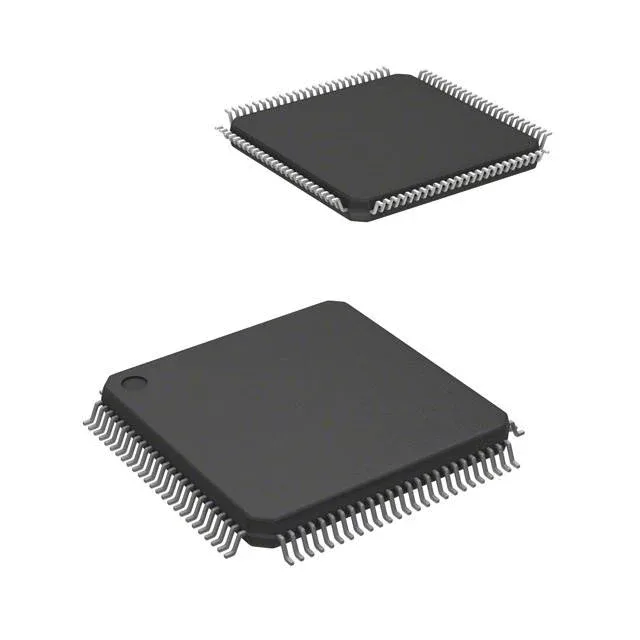
80 MHz Cortex-M3 with 384 KB flash — the real-time control ceiling
The LM3S2U93-IQC80-A2T: The 32-bit core at this speed delivers deterministic interrupt response for motor-control loops, sensor fusion, and industrial protocol stacks where the firmware must service a fieldbus cycle without jitter.
Industrial temperature grade and peripheral set
The internal oscillator eliminates an external crystal for the core clock, though the I²S and CAN peripherals may still need a precision reference for bit-rate accuracy. On-chip peripherals include DMA for memory-to-peripheral transfers without CPU load, a PWM module for motor drive or LED dimming, a watchdog timer for fail-safe reset, and brown-out detection that holds the core in reset until the supply rail is stable. The 16-channel 10-bit ADC samples analog inputs from sensors or potentiometers — enough resolution for threshold detection but not for precision measurement without external reference.
Connectivity mix for industrial and embedded buses
The device integrates CAN 2.0B for industrial fieldbus networks, multiple UART/USART channels for RS-232 or RS-485 links, I²C and SPI for local sensor and memory expansion, and an external bus interface (EBI/EMI) for parallel SRAM, NOR flash, or an FPGA register map. The QEI peripheral decodes quadrature encoder signals directly — useful for motor position feedback without an external decoder IC.
Texas Instruments has marked the LM3S2U93-IQC80-A2T as obsolete. No pin-compatible direct replacement exists in the current TI portfolio — a board redesign or software migration to a newer Cortex-M4 or M7 part would be required for new production.