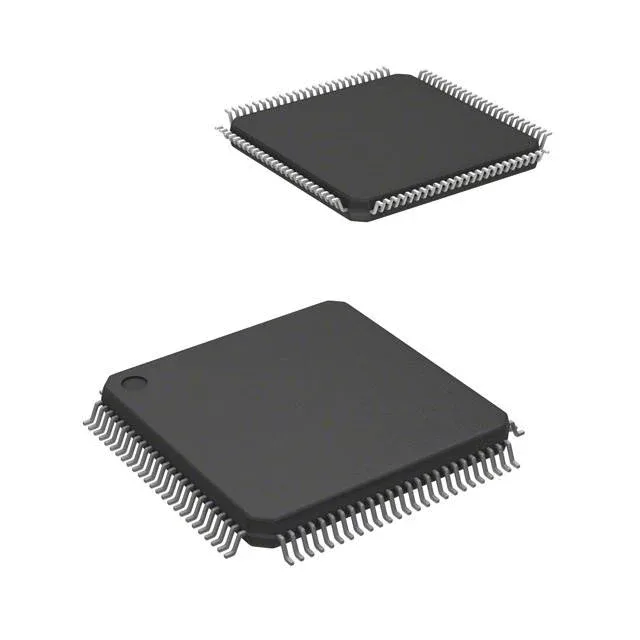
Cortex-M3 with 384 KB flash and 96 KB RAM
The Texas Instruments LM3S2U93-IQC80-A1 is a Stellaris-series ARM Cortex-M3 MCU running at 80 MHz. The 32-bit Cortex-M3 core handles single-cycle multiply and hardware divide, and the 80 MHz clock means the core can sustain around 1.25 DMIPS/MHz — roughly 100 DMIPS — before the flash wait-states start to bite. Step through the boot ROM first to confirm the flash accelerator settings; the default prefetch buffer makes a difference on random-access code. This part is now classified as Obsolete by Texas Instruments.
The LM3S2U93 brings a CANbus controller, an external bus interface (EBI/EMI) for parallel memory or FPGA glue, plus the usual I²C, SPI/SSI, and UART/USART serial ports. The Microwire and IrDA support are legacy-friendly but still useful if the board mates with an older sensor or a remote-control receiver. 67 GPIOs in the 100-LQFP package leave most pins free after the serial interfaces are allocated. On-chip peripherals include a DMA engine, a PWM module, an I²S audio interface, a watchdog timer, and brown-out detect with POR. The 16-channel 10-bit ADC samples at up to 1 Msps — enough for a joystick, a few potentiometers, or current-sense inputs on a motor-control board, though the 10-bit resolution limits precision below what a 12-bit part would deliver. The internal oscillator saves a crystal on low-cost designs, but the accuracy is typically ±1% across temperature — the errata sheet should be checked if the CAN or USB timing requires a tighter clock source.
Package, supply, and temperature range
The exposed pad (if present on this variant) should be stitched to the ground plane with at least nine vias to keep the thermal impedance below 40 °C/W. The I/O ring runs from the same Vdd or an external 3.3 V rail depending on the pin group; the datasheet's power-sequence diagram should be followed to avoid latch-up on power-up. The 100-LQFP package is MSL-3 typical; bake before reflow if the moisture-barrier bag is punctured.