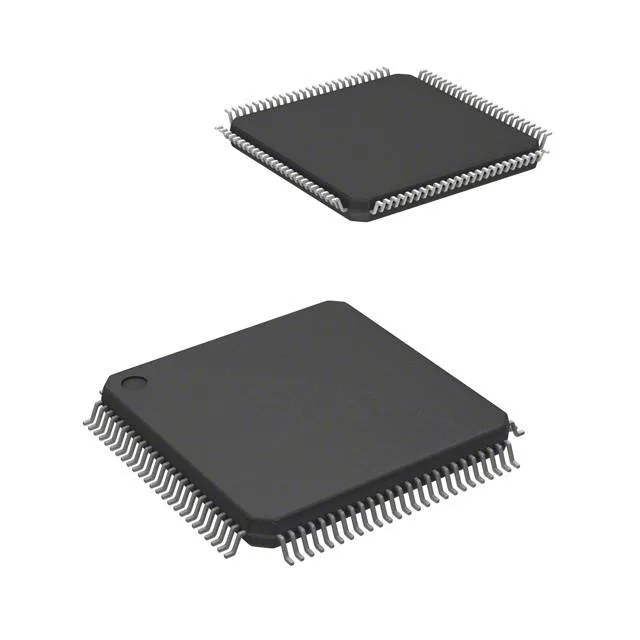
Cortex-M3 core at 50 MHz — flash and SRAM budget
The LM3S2965-EQC50-A2T: The flash holds a full application image plus a bootloader; the SRAM leaves room for a real-time control stack but is tight for large frame buffers.
Peripheral set for motor-drive and industrial control
Connectivity includes CAN, I2C, SPI, UART, and a quadrature encoder interface (QEI) — the QEI reads motor position directly from an incremental encoder, while CAN handles fieldbus communication in a multi-drive network. The PWM module and watchdog timer support unattended operation in a VFD or servo drive. The 4-channel 10-bit ADC samples analog feedback at moderate resolution — sufficient for current-sense shunt monitoring with external amplification, but a 12-bit or higher ADC is needed for precision sensor front-ends.
NRND — not for new designs
Texas Instruments lists the LM3S2965-EQC50-A2T as NRND (Not Recommended for New Designs). Existing BOM lines can continue through independent distribution, but new projects should select a current-generation Cortex-M3 or M4 part from the same family. The 100-LQFP 14x14 mm package with 0.5 mm pitch requires a 4-layer PCB for fan-out of the inner signal rows. The supply voltage is a narrow 2.25 V to 2.75 V rail — a 3.3 V-only system needs a regulator, and some peripherals may require level translation.
Temperature grade and deployment context
The flash retention at 105 °C is the endurance limit — data retention degrades above 85 °C, so the application must budget for periodic refresh if the junction stays near the upper bound.