NRND — what that means for your BOM
Texas Instruments lists the LM3S2950-IBZ50-A2 as NRND (Not Recommended for New Designs). That means it is still available for existing production runs, but TI will not support it in new projects — no new datasheet revisions, no process updates, and eventually a last-time-buy notice. If you have this on an active BOM, the window to secure lifetime-buy quantities is open but finite. For a new design, look for a pin-compatible or functionally equivalent replacement in the same Stellaris family before the layout locks.
The core is an ARM Cortex-M3 running at 50 MHz — plenty for a control-loop or protocol-stack workload that does not need the overhead of a full MPU. The 2.25 V to 2.75 V supply rail means this part runs from a 2.5 V rail, not the common 3.3 V — check your regulator before dropping it into a legacy 3.3 V design.
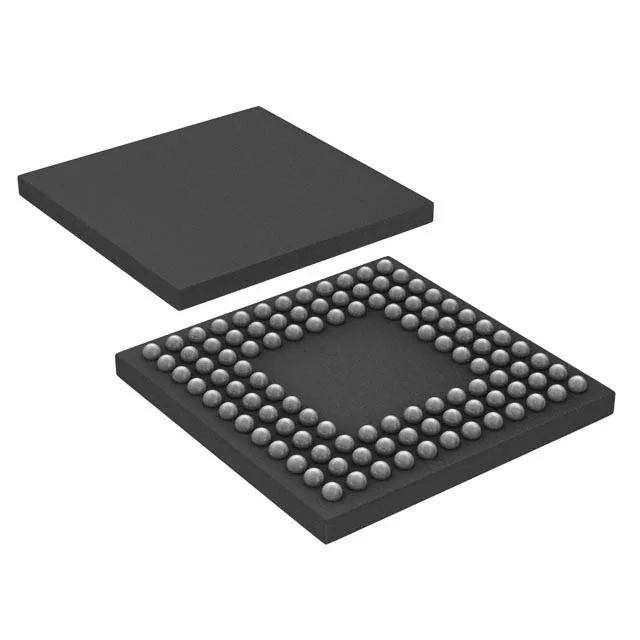
108-ball BGA — board-fit checklist
Package is a 108-ball LFBGA, 10x10 mm body (supplier device package 108-BGA). The 0.80 mm ball pitch is manageable on a 4-layer board with blind vias; a 2-layer board will struggle to fan out the inner rows.
Peripherals and connectivity
On-chip peripherals include brown-out detect, POR, PWM, and a watchdog timer — enough to supervise a standalone controller without an external supervisor IC. Connectivity covers CANbus, I²C, IrDA, Microwire, QEI, SPI, SSI, and UART/USART — the CAN and QEI interfaces make this a natural fit for a motor-control node or a sensor hub on a CAN-based fieldbus. 60 general-purpose I/O pins give plenty of headroom for parallel displays, keypads, or a bank of external ADC channels.