What the NRND status means for your BOM
Texas Instruments has designated the LM3S2948-IBZ50-A2 as Not Recommended for New Designs (NRND). This means the part is still available for existing production but is not intended for new design-ins — TI may discontinue it without further notice. For a BOM that already carries this order code, the NRND flag means you should evaluate a migration path.
Core processing and memory fit
The ARM Cortex-M3 core runs at 50 MHz — this is the throughput ceiling for the control loop or protocol stack. The 32-bit single-core architecture handles 32-bit arithmetic and memory addressing natively, which matters for applications that process sensor data or run control algorithms with 32-bit coefficients.
On-chip peripherals include a brown-out detect, power-on reset, PWM outputs, and a watchdog timer — these cover the basic housekeeping for an embedded controller without external supervisor ICs. The connectivity block supports CANbus, I²C, IrDA, Microwire, SPI, SSI, and UART/USART interfaces. This range covers industrial fieldbus (CAN), serial sensor buses (I²C, SPI), and legacy synchronous protocols (Microwire, SSI) in a single chip. An 8-channel 10-bit ADC is integrated for analog inputs — enough for reading potentiometers, current shunts, or temperature sensors without an external converter.
Package and temperature grade
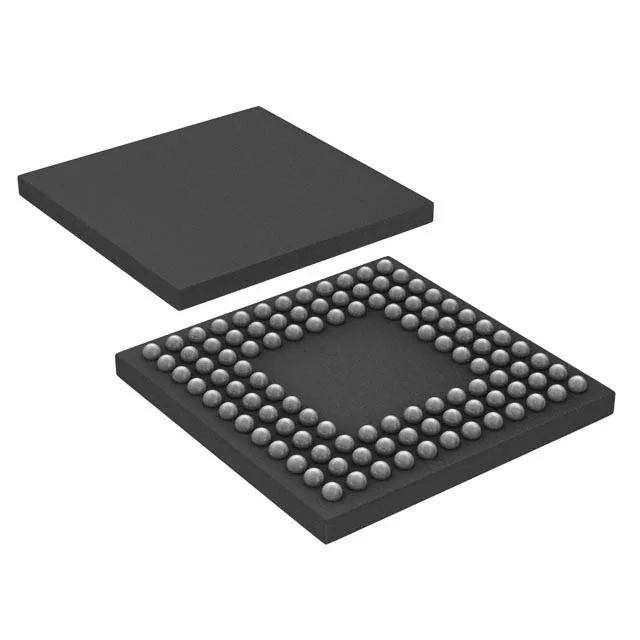
Housed in a 108-ball LFBGA (10x10 mm body), the LM3S2948-IBZ50-A2 requires a multilayer PCB with via-in-pad or microvia fan-out for the 0.50 mm ball pitch. The 52 general-purpose I/O are distributed around the perimeter, so the breakout density is manageable on a 4-layer board.