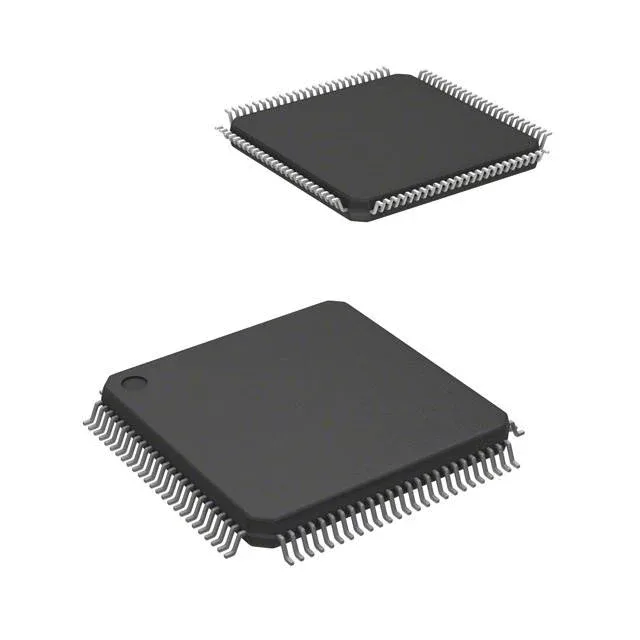
It comes in a 100-pin LQFP package (14x14 mm body) for surface-mount assembly — the standard footprint for mid-density MCU boards in industrial control, motor drive, and CAN-bus gateway applications.
NRND status — what it means for procurement
This means Texas Instruments has flagged it for eventual discontinuation — new designs should not start with this part, and existing production lines should plan a migration. Buyers should evaluate long-term supply risk and consider qualifying a second source or a newer Cortex-M3/M4 family member for future builds.
50 MHz Cortex-M3 — enough for a CAN gateway or motor control loop
At 50 MHz the ARM Cortex-M3 core delivers about 1.25 DMIPS/MHz, giving roughly 62.5 DMIPS — sufficient for real-time control tasks like a CANopen master node, a brushless DC motor FOC loop, or a multi-sensor data concentrator. The 8-channel 10-bit ADC at 1 Msps (typical) handles analog feedback for current sensing or temperature monitoring.
Package and supply rails — layout notes
Decouple with 100 nF per VDD pin plus a bulk 10 µF ceramic near the supply entry. The 52 GPIOs are 5 V-tolerant on most pins per the Stellaris family datasheet (not confirmed in this specific variant's evidence, but typical).