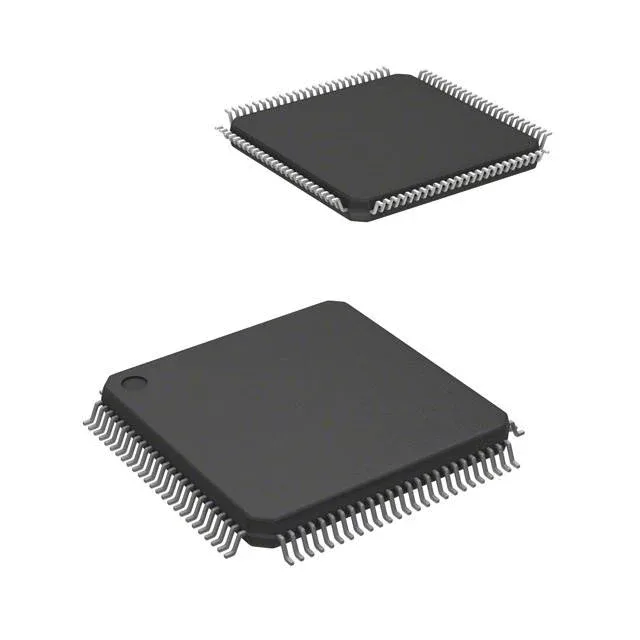
Stellaris Cortex-M3 with 50 MHz core and 256 KB Flash
The LM3S2939-EQC50-A2T: The Flash holds the application firmware plus a bootloader; the 64 KB RAM leaves room for several CAN message buffers, a TCP/IP stack heap, and sensor data arrays without needing external SRAM on the board.
Peripheral set for industrial connectivity
The connectivity block includes CANbus, I²C, SPI, SSI, UART/USART, IrDA, Microwire, and a quadrature encoder interface (QEI). CANbus is the standout for industrial automation — it lets this MCU talk directly to motor drives, I/O blocks, and remote sensors over a two-wire differential bus without an external CAN controller. The QEI input decodes incremental encoder signals for closed-loop motor position feedback. Three 10-bit ADC channels handle basic analog sensing — thermistor temperature, potentiometer position, or current-shunt voltage. The 57 GPIOs map to the 100-LQFP package; about 40 remain after the serial peripherals and ADC are assigned, which is enough for a keypad matrix, status LEDs, and a few discrete control lines. On-chip brown-out detect and POR eliminate the external supervisor IC in many designs. The internal oscillator starts the core without a crystal, though the application note recommends an external 8-16 MHz crystal for CAN timing accuracy — the internal RC tolerance at 50 MHz is tight enough for UART but marginal for CAN bit timing at higher bus speeds.
Industrial temperature grade and supply rail
The -40°C to 105°C operating range qualifies this MCU for engine-bay electronics, outdoor telecom cabinets, and factory-floor controllers that see thermal cycling. The 2.25 V to 2.75 V supply rail means a single 2.5 V LDO powers the core and I/O — no separate 1.8 V rail needed for the Cortex-M3 logic.
Texas Instruments has marked the LM3S2939-EQC50-A2T as Obsolete. The Stellaris family was migrated to the Tiva C series, but those parts use a different pinout and peripheral map — a board redesign is required to move to a Tiva or other current Cortex-M4 device. Available through independent distribution channels. No stock-holding claim — this is a per-order procurement line for BOM fills or last-time-buy extensions.