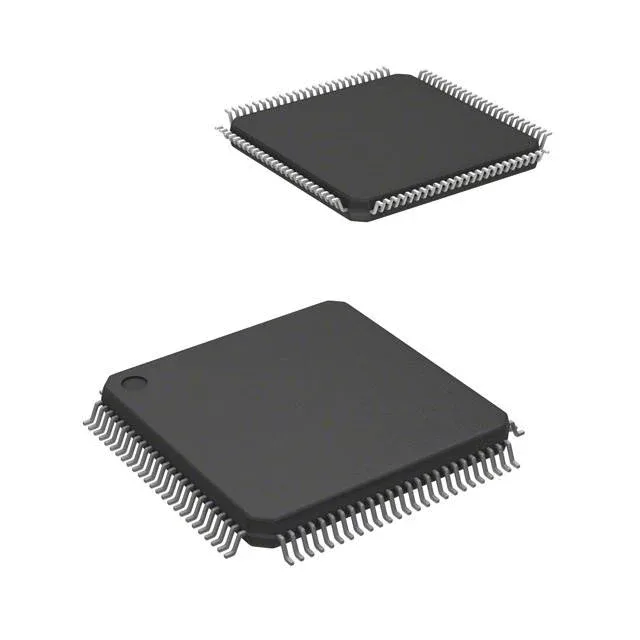
That means TI has signaled it won't be the target for future spin-tapes or volume allocations — though it remains available through the independent channel for existing production runs and repair stock. If you're qualifying a new board, you'll want to look at the current Stellaris or TM4C family alternatives; for a repair or a last-production run, this is the exact die you need to match the existing firmware and PCB layout.
The 50 MHz core delivers 1.25 DMIPS/MHz, so about 62.5 DMIPS — enough to run a CANopen stack, a Modbus RTU slave, and a PID loop on a motor drive without breaking a sweat. The internal oscillator means you can skip the external crystal for applications that don't need precision timing, saving two pins and a couple of passives.
Peripherals that matter for industrial and CAN-bus designs
The CAN 2.0B controller is the standout here — it's what separates this part from the general-purpose Cortex-M3 parts that only do UART and SPI. The CANbus interface, combined with the 60 I/O and the PWM and WDT peripherals, makes this a natural fit for industrial control nodes, motor drives, and building automation gateways. The brown-out detect and POR keep the firmware from corrupting Flash on a glitchy supply — a real concern on factory floors with big motors cycling on and off.
Package and temperature grade — fits the industrial panel
If your board lives in a conditioned server room, you've got margin; if it sits next to a furnace or a compressor, you're still inside the rated window.