Obsolete — sourcing strategy for the LM3S2739-EQC50-A2T
For existing BOM lines, the supply channel is limited to independent distribution and surplus inventory.
50 MHz ARM Cortex-M3 — what the core speed means for your application
This is a mid-range speed tier for the Cortex-M3 architecture — enough for real-time control loops, CAN gateway processing, and sensor fusion, but not for high-rate DSP or video. The 50 MHz core, combined with the single-cycle multiply and hardware divide of the M3, gives deterministic interrupt latency suitable for motor drive and industrial automation applications where the 56 available I/O lines and rich serial connectivity are the primary draw.
Program memory is 128 KB of on-chip Flash, and the SRAM is 64 KB organized as 64K x 8. The 64 KB RAM provides reasonable headroom for data buffers, communication stacks, and local variables. If your firmware image exceeds 128 KB, this part will not fit without external memory, which the part does not have a dedicated external bus interface for.
The 105°C upper limit suits motor drive cabinets, outdoor telecom enclosures, and factory-floor automation where ambient temperatures can exceed 85°C. This is a critical BOM detail: the board must have a dedicated 2.5 V supply, or you need a regulator.
The peripheral set includes CANbus, I²C, IrDA, Microwire, QEI, SPI, SSI, and UART/USART interfaces. The CAN controller is a key differentiator for industrial and automotive networking — this part can act as a CAN node without an external controller. The QEI (quadrature encoder interface) is purpose-built for motor position feedback from incremental encoders. The 4-channel 10-bit ADC provides basic analog measurement capability.
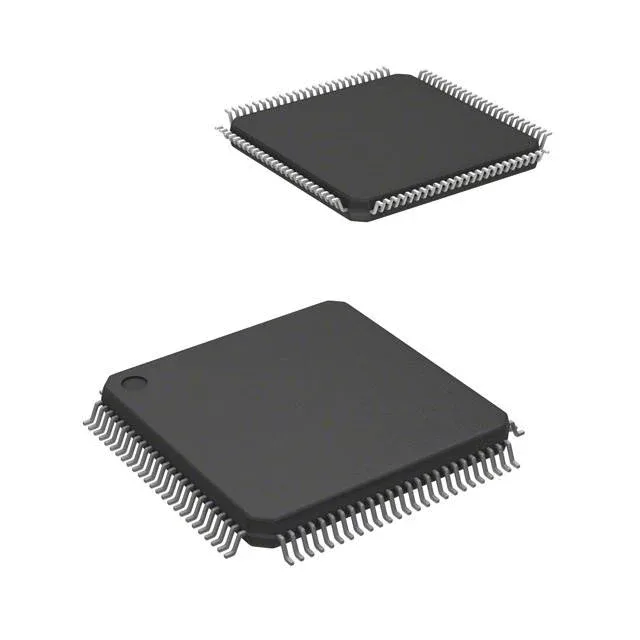
Package and footprint — 100-LQFP
The LM3S2739-EQC50-A2T is supplied in a 100-LQFP package (14x14 mm body). This is a common fine-pitch QFP that requires careful PCB layout for the 56 I/O lines and supply pins.