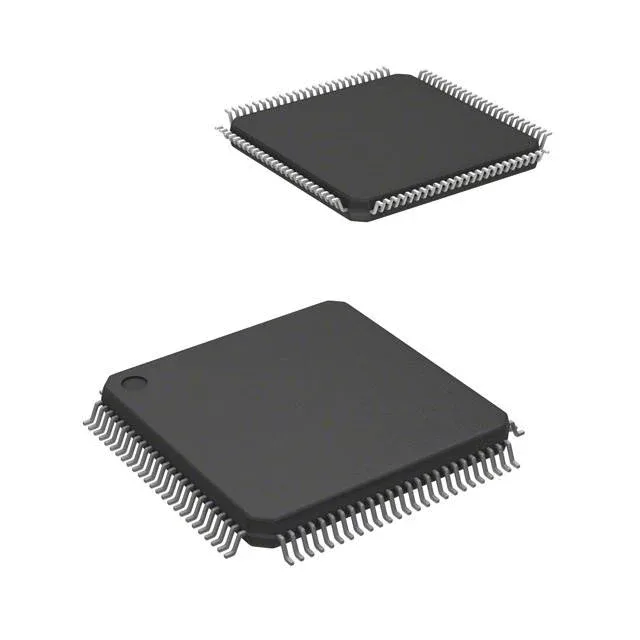
100-LQFP Cortex-M3 with CAN and industrial temp range
The Texas Instruments LM3S2651-IQC50-A2T is a Stellaris-series ARM Cortex-M3 microcontroller in a 100-pin LQFP package (14x14 mm).
Peripheral mix and I/O budget
With 53 general-purpose I/O lines and a connectivity block that includes CANbus, I²C, SPI, SSI, UART/USART, and IrDA, this MCU can bridge multiple serial buses in a single node. The four 10-bit ADC channels handle basic analog sensing without an external converter. On-chip peripherals include a brown-out detect/reset, POR, PWM outputs, and a watchdog timer — enough to implement a simple motor-control or sensor-fusion loop without external supervisory ICs.
NRND lifecycle — what it means for procurement
Texas Instruments has designated the LM3S2651-IQC50-A2T as NRND (Not Recommended for New Designs). This means the part is still available for existing production but is not intended for new design-ins. For BOM lines already using this MCU, sourcing through independent distribution is the practical path.
Board integration — 100-LQFP footprint
The 100-LQFP with 0.5 mm pitch demands a multi-layer PCB for fan-out — a two-layer board will struggle to route all 53 I/O plus the power and ground planes. The 14x14 mm body with an exposed pad (if present on this variant) needs a thermal via array under the package to keep the junction temperature within the -40 to +85°C operating range. Supply decoupling should follow the 2.25 V to 2.75 V rail tolerance — a 2.5 V LDO with 200 mV dropout margin covers the full range.