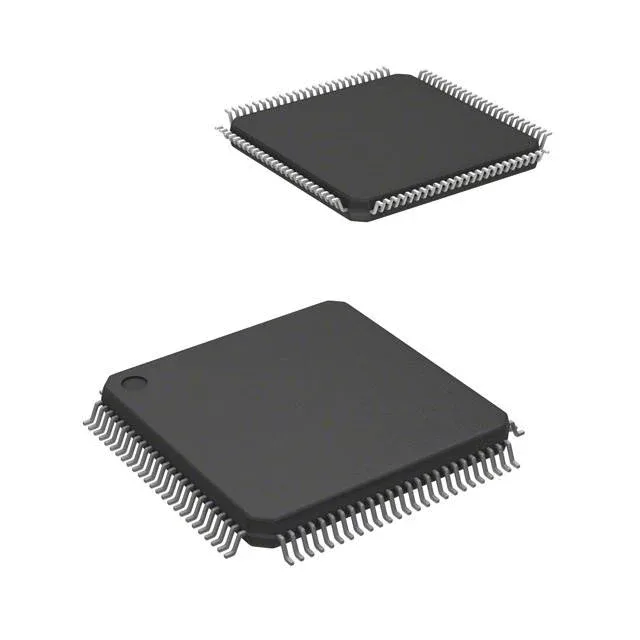
Texas Instruments LM3S2637-EQC50-A2T — Microcontrollers & Processors (MCU / MPU / DSP)

LM3S2637-EQC50-A2T Stellaris ARM Cortex-M3 MCU, 50MHz

MPNLM3S2637-EQC50-A2T
Obsolete

Texas Instruments Stellaris ARM Cortex-M3S 2000 series LM3S2637-EQC50-A2T, 32-Bit Single-Core MCU, 50MHz, 128KB Flash, 32K x 8 SRAM, CANbus, 46 I/O, -40°C~105°C, 100-LQFP.

Independent supplier — new & surplus stockAuthenticity-screened · ESD-safe packingListing updated Jul 2026

Specifications

LM3S2637-EQC50-A2T specifications
ParameterValue
SeriesStellaris® ARM® Cortex®-M3S 2000
MountingSurface Mount
Oscillator typeInternal
Program memory typeFLASH
Voltage - supply (Vcc (Vdd))2.25V ~ 2.75V
Operating temperature-40°C~105°C(TA)
Speed50MHz
PackageTape & Reel (TR)
RAM size32K x 8
Core size32-Bit Single-Core
PeripheralsBrown-out Detect/Reset, POR, PWM, WDT
ConnectivityCANbus, I²C, IrDA, Microwire, SPI, SSI, UART/USART
Number of i (O)46
Core processorARM® Cortex®-M3
Case100-LQFP
Data convertersA/D 4x10b
Program memory size128KB (128K x 8)

Product details

50MHz Cortex-M3 with CAN — the fit call

The 50MHz clock is the headline number — it sets the ceiling for control-loop bandwidth, protocol processing, and general throughput. For a motor-drive or CAN gateway node running a modest protocol stack, 50MHz is adequate; if your application needs floating-point or heavy DSP, you would be looking at a Cortex-M4 or M7 part instead. The CANbus interface plus I2C, SPI, SSI, UART/USART, IrDA, and Microwire connectivity makes this a flexible node controller for industrial automation, building control, or automotive body-electronics modules. With 46 GPIOs in a 100-LQFP package, you have enough pins for a parallel LCD, keypad matrix, and sensor inputs alongside the serial buses.

Temperature range and supply — the field constraints

The supply range is 2.25V to 2.75V — that is a tighter window than the usual 3.3V ±10% rail. Your regulator needs to hold 2.5V within that band across load and temperature; a standard 2.5V LDO with 2% tolerance will work, but check dropout at the low end. The 100-LQFP (14x14 mm) package is a hand-solderable, inspectable footprint — no hot-air station required for rework. If you are swapping this on a customer site, the orientation is obvious: pin 1 chamfer on the top-left corner. Standard ESD handling applies, but the package is robust enough for field replacement with a basic soldering iron and flux.

What is in the kit — peripherals and memory

Four 10-bit ADC channels cover basic analog sensing (potentiometers, thermistors, current shunts).

Frequently asked questions

What is the replacement for LM3S2637-EQC50-A2T?

Texas Instruments has not published a direct pin-compatible replacement. For a drop-in fit, the best option is to source the original part through independent distribution. For a new design, you would evaluate current TI Cortex-M4 or TM4C series parts with CAN and 46+ I/O in a 100-LQFP, but those will require a PCB layout change and firmware port.

Can LM3S2637-EQC50-A2T be used as a replacement for LM3S2637-IQC50-A2T?

The LM3S2637-EQC50-A2T and LM3S2637-IQC50-A2T share the same base part number and core specs — both are 50MHz Cortex-M3 with 128KB Flash and 32K x 8 SRAM. The -EQC can replace the -IQC in any application since its temperature range covers the narrower one. Pinout and footprint are identical.