What the 50 MHz core and memory budget mean for a control application
The LM3S2533-IBZ50-A2T runs an ARM Cortex-M3 core at 50 MHz — enough throughput for a closed-loop PID controller updating at 10 kHz with headroom for the protocol stack and diagnostics. The 96 KB on-chip Flash and 64 KB SRAM leave room for a moderate application image and a real-time data buffer; a CANopen stack with 32 PDO mappings fits within that footprint without external memory. Operating from -40°C to 85°C, this MCU is qualified for unheated enclosures in factory-floor or outdoor cabinet environments. The 2.25 V to 2.75 V supply rail is tighter than the 3.3 V typical for Cortex-M3 parts — the board's regulator must hold within that band across load steps.
NRND lifecycle — what it means for a BOM line
Texas Instruments lists the LM3S2533-IBZ50-A2T as NRND (Not Recommended for New Designs). This is the official lifecycle status — the part is still available for existing production but is not intended for new board spins. No pin-compatible successor is recorded in the official documentation; a migration to a current Stellaris or Tiva-C series part would require a package and peripheral audit. For a sustaining BOM, the NRND flag means the supply window is finite. Sourcing through independent distribution channels is the practical path — availability is confirmed per RFQ, and the reel quantity (Tape & Reel packaging) is typical for this class. No last-time-buy date is published, so the procurement trigger is the next scheduled BOM review.
108-BGA package — layout and rework notes
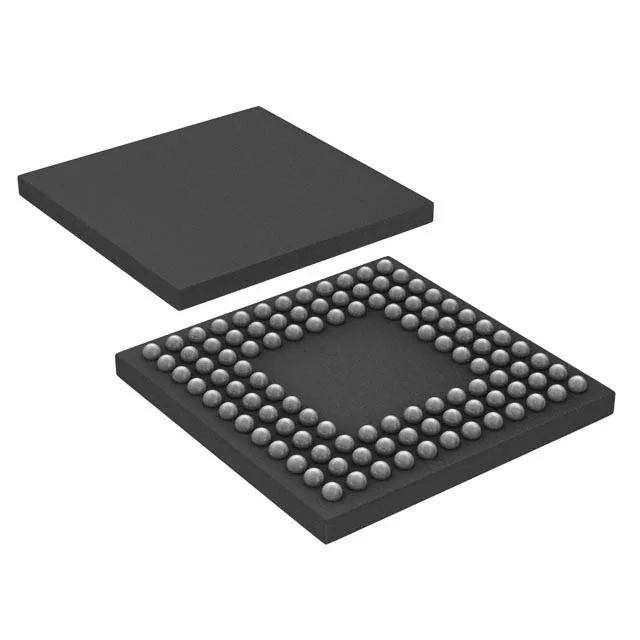
The 108-ball BGA (10x10 mm body) has a 0.80 mm ball pitch — a 4-layer PCB with via-in-pad or microvias is the standard fan-out. The supplier device package is 108-BGA (10x10), so the footprint matches the JEDEC MO-216 standard for this ball count. The 48 GPIOs are distributed across the BGA perimeter — the pin map is in the TI datasheet. Brown-out detect, POR, PWM, and WDT are integrated peripherals, so the only external components needed are the decoupling caps and the supply regulator. The internal oscillator eliminates the external crystal for applications that can tolerate ±2% accuracy over temperature.