What the 50 MHz Cortex-M3 core means for your control loop
The LM3S2533-EQC50-A2 runs a 32-bit ARM Cortex-M3 core at 50 MHz — this is the processing ceiling for your interrupt service routine and main loop combined. For a motor-control loop reading a 10-bit ADC, running a PI controller, and updating a PWM duty cycle, 50 MHz gives you roughly 500 instructions per microsecond of loop time, which is enough headroom for a 10 kHz current loop with margin left for communications overhead. The 96 KB of on-chip flash holds the firmware image; 64 KB of SRAM buffers real-time data, communication stacks, and intermediate calculations. That 64 KB SRAM is enough for a CANopen stack plus a few hundred sensor readings before you need to flush to external storage.
Connectivity and I/O — what interfaces are on the pins
This MCU brings out CANbus, I2C, SPI, SSI, UART/USART, and Microwire — a broad enough set to talk to industrial sensors, motor drives, and HMI panels without external protocol converters. The 48 GPIOs map to the 100-pin LQFP package; about 30 of those are usable after the dedicated peripheral pins are allocated. Three 10-bit ADC channels sample analog signals like potentiometer feedback or current-sense amplifier outputs. The internal oscillator means you can bring up a UART bootloader without an external crystal, though the internal RC accuracy (±1% typical) limits precision timing applications.
Temperature range and supply — where it lives on the board
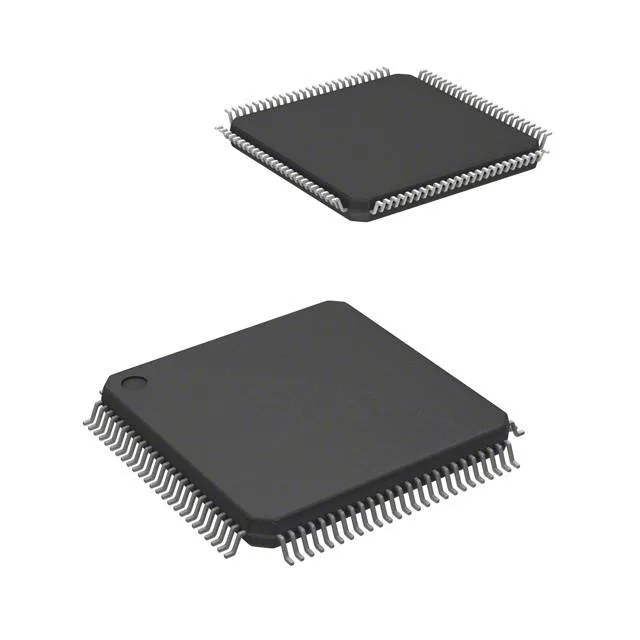
The 100-LQFP package with a 14x14 mm body is a hand-solderable fine-pitch package (0.5 mm pitch). Standard PCB assembly lines handle it without issue; rework with hot air is straightforward if you preheat the board to 100°C.
Lifecycle reality — why this part is a sourcing special
Sourcing this part today means going through independent distribution channels that hold new-old-stock or surplus inventory. Each lot is traceable and tested; quantities are confirmed at RFQ time. If you are supporting a legacy production line, buy enough for the remaining build — there will be no last-time-buy window from the factory.