Core and memory — what the 50 MHz and 96 KB flash mean for your firmware
The LM3S2432-IBZ50-A2 runs an ARM Cortex-M3 core at 50 MHz — enough throughput for a PID control loop running at 10 kHz with headroom for protocol parsing on CAN or UART. The 96 KB on-chip flash (96K x 8) and 32 KB SRAM (32K x 8) fit a moderate application stack: a FreeRTOS kernel plus a CANopen stack leaves roughly 40 KB flash and 12 KB RAM for the application layer, so budget tightly if you are adding a TCP/IP stack or large data buffers.
Peripheral set and connectivity — what hooks into the bus
The connectivity block includes CAN, I²C, IrDA, Microwire, SPI, SSI, and UART/USART — this covers fieldbus bridging (CAN to UART gateway), sensor aggregation over I²C, and SPI flash or display interfaces. Three 10-bit ADC channels handle basic analog sensing (potentiometer feedback, thermistor voltage), but the 10-bit resolution limits precision measurement — a 0-10 V sensor gives 9.8 mV per step. On-chip peripherals include brown-out detect, POR, PWM, and watchdog timer — these reduce the external supervisor IC count and simplify the power-on sequence. The internal oscillator eliminates the external crystal for many applications, though the accuracy is adequate for UART baud rates, not for CAN bit timing at high bus speeds.
Package and board integration — BGA layout notes
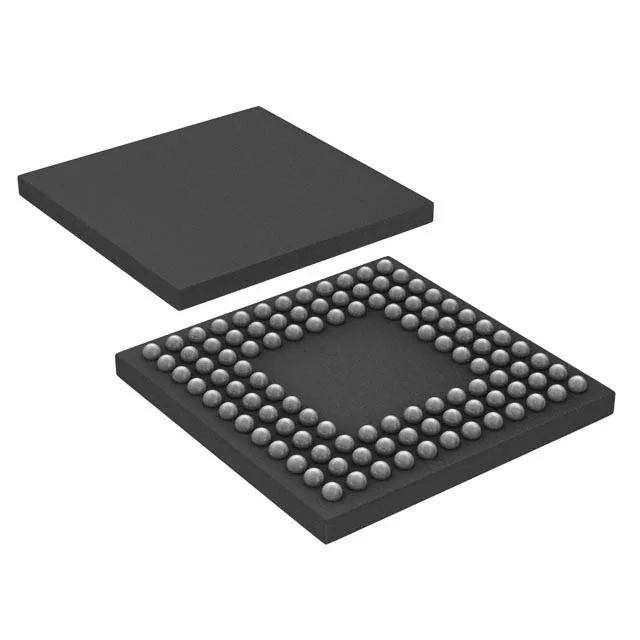
The 108-BGA package (10x10 mm) with 0.80 mm ball pitch demands a 4-layer PCB for fan-out — two-layer boards will struggle to route the inner balls.
Lifecycle reality — NRND and what that means for your BOM
Texas Instruments lists the LM3S2432-IBZ50-A2 as NRND (Not Recommended for New Designs). This means the part is still available for existing production but is not intended for new projects.