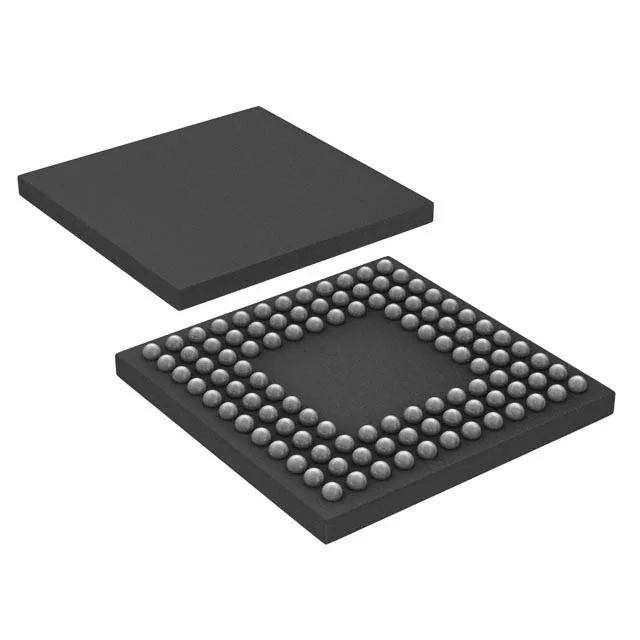
Core identity and flash/RAM budget
The LM3S2412-IBZ25-A2: It carries 96 KB of on-chip flash and 32K x 8 of SRAM — the flash is enough for a modest firmware image with a bare-metal RTOS, but the 32 KB RAM ceiling means the stack and heap budget needs careful partitioning before the linker script is written. The core processor is the ARM Cortex-M3, a single-core 32-bit design with a hardware divide and a 3-stage pipeline. The 25 MHz speed is a hard ceiling — the flash controller's wait states at 25 MHz are manageable, but pushing the core beyond this requires a different part number.
On the connectivity side, the part integrates CANbus, I²C, IrDA, Microwire, SPI, SSI, and UART/USART interfaces — enough to talk to most sensor arrays, actuator drivers, and a CAN bus backbone without external bridge chips. The 49 GPIOs map out across the 108-BGA ball grid; the peripheral multiplexing is documented in the reference manual and must be checked against the board's pin allocation before layout. An internal oscillator eliminates the external crystal for the main clock, saving two pins and a board component. The 3-channel 10-bit ADC is adequate for slow analog monitoring (temperature, voltage sense) but not for high-speed data acquisition — the 10-bit resolution and conversion rate limit it to DC or low-frequency signals. Brown-out detect, POR, PWM, and a watchdog timer are built in — the BOD and POR handle power-up sequencing without an external supervisor, and the WDT can be used to recover from firmware hangs in safety-conscious designs.
Package and temperature grade
The 108-LFBGA package (10x10 mm body) with a 0.8 mm ball pitch is a fine-pitch BGA that requires a 4-layer PCB minimum for fan-out. The supplier device package is 108-BGA (10x10) — the ball map is in the datasheet; route the outer rows first and keep the via-in-pad strategy only if the assembly house can handle it. This covers most factory-floor, outdoor telecom, and automotive cabin applications but does not reach the 125°C under-hood requirement. Supply voltage is 2.25 V to 2.75 V — a single 2.5 V rail works, but a 3.3 V system needs a regulator.
Lifecycle reality — NRND
Texas Instruments lists this part as NRND (Not Recommended for New Designs). The part is still available for existing production runs, but TI is not actively supporting new design wins on this order code. Any new board should target a current-generation Stellaris or Tiva-C series MCU with a similar pinout and peripheral set. The 108-BGA footprint is common across several Stellaris parts, so a pin-compatible migration may be possible with a firmware recompile.