At 25 MHz the Cortex-M3 delivers a predictable 1.25 DMIPS/MHz, so you get roughly 31 DMIPS of integer throughput. That is enough to handle a CAN message frame at 1 Mbps with CPU cycles left for sensor polling and a PID loop, but not enough for heavy DSP or high-rate data logging. The internal oscillator means you can skip an external crystal for non-critical timing, though CAN bus timing will need the PLL locked to a known reference for bit-rate accuracy.
Memory sizing for the firmware and data path
96 KB of Flash (96K x 8) and 32K x 8 of SRAM place this MCU in the mid-range of the Stellaris family. The Flash holds a moderate application stack — a CANopen stack plus a bootloader and application code fits comfortably. The 32K x 8 SRAM gives about 32 KB of working memory; if your application needs large frame buffers or a TCP/IP stack, you will bump against that ceiling quickly. For control-loop data and small packet buffers it is adequate.
Peripherals and I/O for industrial control
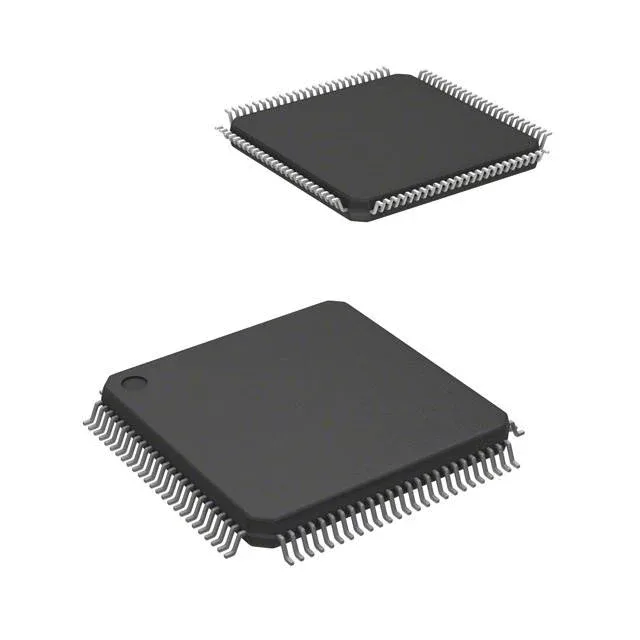
With 60 I/O lines in the 100-LQFP package, you have enough pins to drive a keypad, a small character LCD, and a handful of sensors alongside the serial interfaces.
That means TI has signaled this part is on the path to end-of-life — no new production allocation is guaranteed, and future LTB windows may close. For existing production, the part remains available through independent distribution on a sourced-to-order basis.