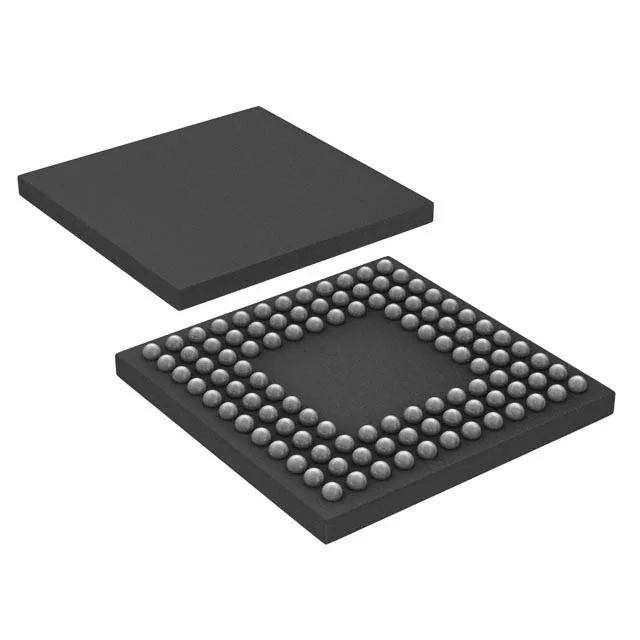
The LM3S2410-IBZ25-A2: For a board that already carries this Stellaris Cortex-M3S 2000 part, the NRND flag is a signal to review the BOM for a migration path before TI issues the final EOL notice.
Core and memory — what 25 MHz and 96 KB get you
The ARM Cortex-M3 core runs at 25 MHz — enough for a control loop sampling sensors at a few kilohertz or handling CAN message traffic at 1 Mbps without the core pegging at 100 %. The 96 KB on-chip flash (96K x 8) holds a mid-complexity firmware image; the 32K x 8 SRAM leaves room for a modest stack and a few ring buffers. The 32-bit single-core architecture with internal oscillator means you can skip an external crystal for applications that tolerate the internal RC accuracy — saves two pins and a couple of passives on the BOM.
Package and board-fit — 108-ball BGA
Housed in a 108-LFBGA, the supplier device package is a 108-BGA measuring 10x10 mm. The 0.80 mm ball pitch is reworkable with a standard hot-air station if you have a pre-heater under the board — the reflow profile follows JEDEC J-STD-020 for a 2.25 mm-thick PCB. Surface-mount only — no socket option. The 60 GPIOs fan out to the outer two rows of the BGA; a four-layer board with ground plane under the BGA keeps the supply clean for the 2.25 V to 2.75 V rail.
Connectivity and peripherals for industrial duty
The peripheral set includes CANbus, IrDA, Microwire, SPI, SSI, and UART/USART — covers the common industrial fieldbus and sensor interfaces without external protocol chips. The on-chip brown-out detect, POR, PWM, and watchdog timer reduce the external supervisory IC count. A motor-drive controller in a non-conditioned cabinet or a PLC module on a factory floor stays within the junction temperature envelope.