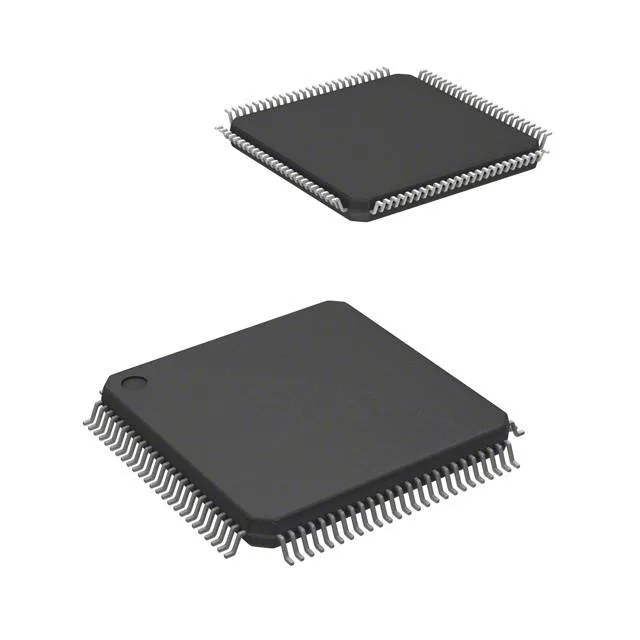
The LM3S2139-IQC25-A2: On-chip memory: 64 KB Flash for firmware and 16 KB SRAM for data buffers. That 16 KB RAM is enough for a CAN message queue of a few hundred frames plus a modest RTOS heap, but a data-logging application that accumulates samples over seconds will need to stream out over SPI or UART rather than buffer locally. The 56 GPIOs in a 100-LQFP package give you room for a parallel LCD interface, a keypad matrix, and a handful of sensors without multiplexing.
Peripherals and connectivity for industrial control
Connectivity includes CAN 2.0B, SPI, UART, I2C, and SSI — the CAN interface is the key differentiator for industrial or automotive sub-networks where you need multi-drop communication without a central controller polling each node. On-chip peripherals: brown-out detect, POR, PWM, and watchdog timer. The brown-out and POR mean you can skip an external supervisor IC in many designs — the MCU holds reset until the 2.25 V minimum supply is stable. The 4-channel 10-bit ADC is useful for reading potentiometers, current-sense resistors, or thermistors — not high-resolution, but enough for a closed-loop fan controller or a battery-monitoring front end.
Lifecycle reality — NRND and what that means for sourcing
Texas Instruments lists this part as NRND (Not Recommended for New Designs). That means it is still available for existing production but not intended for new board spins — TI will not guarantee long-term supply for fresh designs. For a BOM that already uses this MCU, the NRND status means you should plan a migration to a current Stellaris or Tiva-C device.