What the 25 MHz core and memory mean for fit
The LM3S2139-IBZ25-A2T: The 25 MHz clock rate and Cortex-M3 pipeline deliver roughly 0.9 DMIPS/MHz, so the effective throughput is about 22 DMIPS — adequate for control-loop tasks like motor commutation, CAN message handling, or sensor fusion where the peripheral set does the heavy lifting. 64 KB of program Flash and 16 KB of SRAM leave room for a modest RTOS kernel plus application code; the 56 GPIO lines (in the 108-BGA) allow parallel interfaces or a large matrix of discrete I/O without an external expander.
Connectivity and peripheral set
On-chip connectivity includes CANbus, I²C, SPI, SSI, UART/USART, IrDA, and Microwire — enough to bridge a CAN-based machine network to a local sensor bus or a UART debug console without external protocol chips. A 4-channel 10-bit ADC, PWM outputs, and a watchdog timer round out the analog and timing resources for closed-loop control.
NRND lifecycle — what it means for procurement
Texas Instruments lists this device as NRND (Not Recommended for New Designs). The part is still orderable for existing production but is not intended for new projects — any new BOM should target a current-generation Stellaris or TM4C substitute.
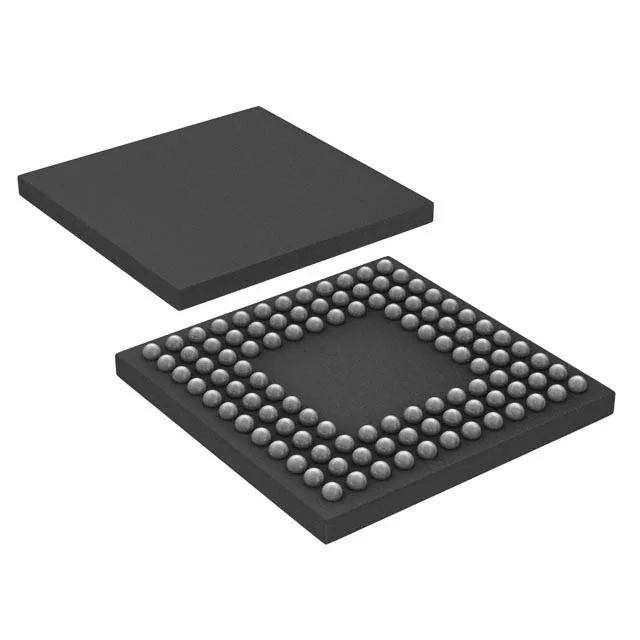
The 108-ball BGA (10x10 mm) with 0.80 mm ball pitch requires a 4-layer PCB for fan-out — the inner rows need at least two signal layers to route cleanly.