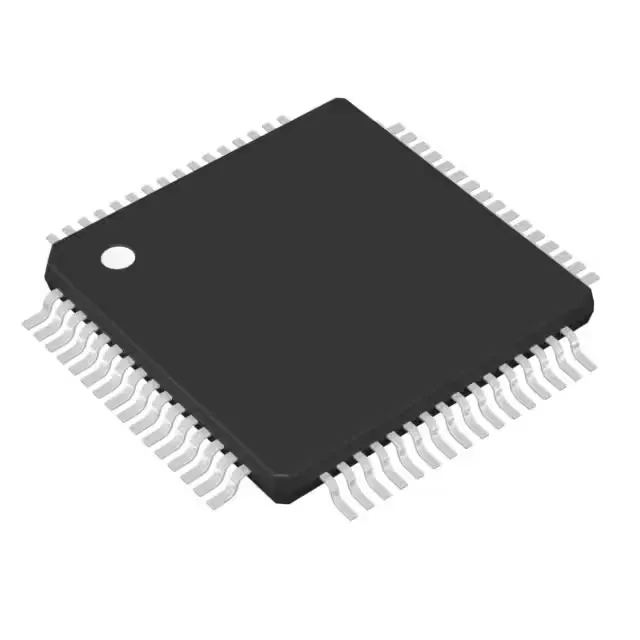
50 MHz Cortex-M3 with 16 KB Flash — what the memory envelope means
The LM3S1Z16-IQR50-C0: With 16 KB of program flash and 6 KB of SRAM, this part fits control applications where the firmware stays under 12 KB after the HAL and RTOS overhead — think sensor polling loops, simple motor commutation, or protocol bridging on a single I²C or UART bus. The 6 KB SRAM (6K x 8) leaves roughly 2–3 KB for the application stack and runtime variables after the core peripheral drivers and interrupt vectors are loaded. If your state machine or data buffer exceeds that, you will need to move to a member with larger RAM in the same Stellaris 1000 series.
Texas Instruments has marked the LM3S1Z16-IQR50-C0 as Obsolete. This part is no longer available through the standard factory or authorized distribution channel for new builds. Quantities are lot-specific and confirmed at RFQ time.
Package and supply — 64-LQFP, 1.08–1.32 V core
Housed in a 64-LQFP with a 10x10 mm body, the 0.5 mm pitch demands a four-layer PCB for reliable fan-out of the inner rows.
Peripheral set — 33 GPIO, 8-channel 10-bit ADC, multiple serial buses
The 33 general-purpose I/O lines support a mix of digital and analog functions. The 8-channel 10-bit ADC samples at rates suitable for low-speed sensor acquisition — think thermistor or potentiometer inputs, not audio or vibration analysis. Serial connectivity covers I²C, SPI, SSI, UART/USART, IrDA, LINbus, and Microwire. The LINbus and IrDA support point to automotive body-electronics and infrared data-link applications respectively, though the industrial temperature grade limits under-hood use. On-chip peripherals include brown-out detect, POR, a PWM module, a watchdog timer, and a DMA controller. The DMA offloads the Cortex-M3 core during peripheral-to-memory transfers, which matters when the 50 MHz CPU is also handling protocol stacks.