Texas Instruments has marked the LM3S1W16-IQR50-C3 as obsolete. The part is no longer available through standard authorized distribution channels. Availability and pricing are lot-specific and confirmed at RFQ time — no stock-holding claim is made here.
Core and memory — what the 50 MHz and 32 KB Flash mean for fit
The ARM Cortex-M3 core runs at 50 MHz, a 32-bit single-core architecture. This clock rate is sufficient for control loops in the tens of kilohertz range, protocol handling (UART, SPI, I²C), and moderate data-logging tasks. It is not suited for DSP-intensive workloads or high-speed motor FOC without an external accelerator. Program memory is 32 KB of Flash, with 8 KB of SRAM. For a typical firmware image including a HAL, RTOS kernel, and application code, budget about 12–16 KB for the binary — leaving 16–20 KB for application logic. The 8 KB SRAM holds stack, heap, and global data; a moderate sensor array or a small display buffer will consume most of it.
Package and supply voltage — board-fit constraints
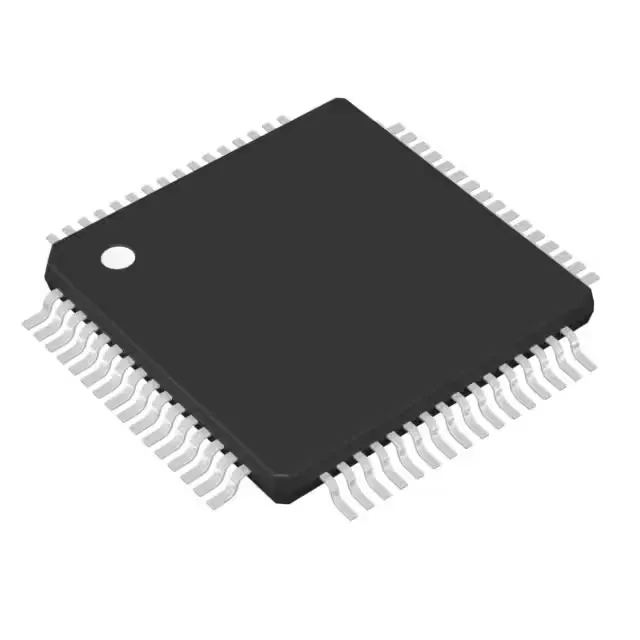
Housed in a 64-LQFP package with a 10x10 mm body, the part uses a 0.5 mm pitch. This dual-supply scheme adds a regulator and decoupling network compared to single-supply 3.3 V MCUs. This qualifies the device for factory-floor automation, outdoor telecom enclosures, and engine-bay-adjacent applications where ambient temperature stays below 85°C.
Peripherals and I/O — what is on-chip
The LM3S1W16 integrates 33 general-purpose I/O lines, an 8-channel 10-bit ADC, and a set of serial interfaces: I²C, SPI, SSI, UART/USART, plus IrDA and LINbus. On-chip peripherals include brown-out detect, POR, DMA, PWM, and a watchdog timer. For a basic control application — reading a few analog sensors, driving a small display, and communicating over a serial bus — this eliminates the need for external ADC or UART chips.