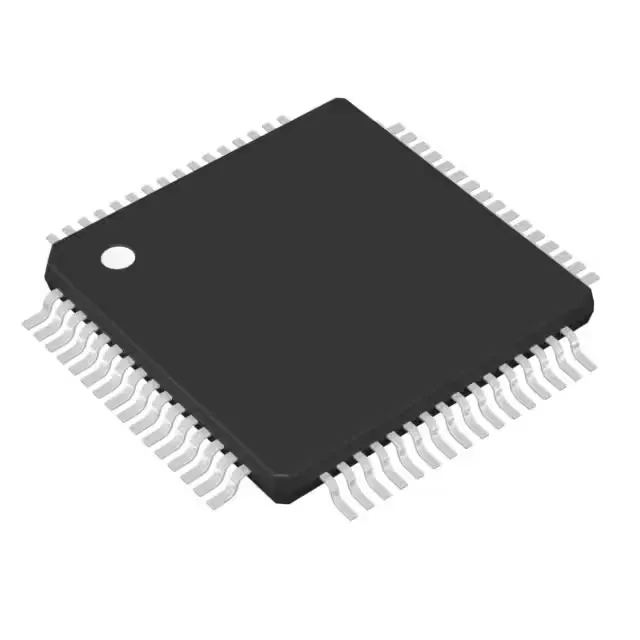
50 MHz Cortex-M3 with 64 KB Flash — what the memory split means for firmware
The LM3S1N16-IQR50-C3T: That 12 KB RAM ceiling is the tight constraint for a real-time control loop — a moderate-size FreeRTOS heap plus a few UART buffers eats most of it, so the linker script needs a careful stack/heap split before the first prototype spins. The part belongs to the Stellaris ARM Cortex-M3S 1000 series, TI's first-generation Cortex-M3 line. It integrates an 8-channel 10-bit ADC, a full set of serial interfaces (I²C, SPI, SSI, UART/USART, IrDA, LIN, Microwire), and PWM channels — enough for a motor-control or sensor-fusion node that does not need external ADC or UART expanders.
Texas Instruments has marked the LM3S1N16-IQR50-C3T as obsolete. The Stellaris family was migrated to the Tiva C series years ago, and TI no longer accepts orders through its authorized channel. Any stock in the field is the last production run — no last-time-buy window remains open. This part is sourced through independent distribution against an RFQ. Every lot is date-code and marking verified — the laser etch on the 64-LQFP package is the primary forensic check. No pin-compatible official successor exists from TI; the Tiva TM4C123 parts are a functional replacement but require a board spin and firmware port.
Supply voltage and temperature grade — industrial range, single-rail simplicity
The exposed paddle on the underside must be soldered to a thermal land on the PCB — without it, the junction-to-ambient thermal resistance rises and the 50 MHz core may throttle or drift oscillator accuracy in sustained operation.