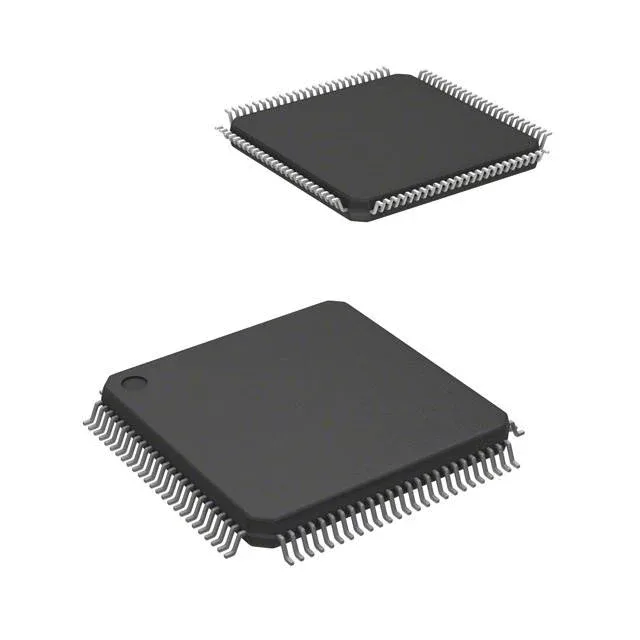
Obsolete Cortex-M3 — sourcing through surplus channels
The LM3S1N11-IQC50-C5: This part is sourced through independent surplus channels; quantities are lot-specific and confirmed at RFQ. The Stellaris® ARM® Cortex®-M3S 1000 series was TI's first Cortex-M3 family, now a legacy design. For new designs, a pin-compatible alternative within the same package footprint is not documented — a board spin is likely required to migrate to a current-generation MCU.
50MHz Cortex-M3 core with 64KB flash ceiling
The 50MHz ARM Cortex-M3 core delivers deterministic interrupt latency and Thumb-2 ISA density, but the flash wait-state profile sets the actual throughput ceiling — the 64KB program memory limits firmware image size to well under 64KB when the bootloader and HAL are accounted for. 12K x 8 RAM leaves roughly 4–6KB free after a minimal RTOS and stack — enough for a single control loop with moderate buffering, but tight for a GUI or multi-protocol stack. The 8-channel 10-bit ADC (A/D 8x10b) integrates analog sensor front-ends without an external converter, but the 10-bit resolution limits dynamic range for precision measurements — a 12-bit external ADC may be needed for 0.1% accuracy.
Industrial temp grade and serial interface mix
The 1.08V to 3.6V supply range allows single-rail battery or regulated 3.3V operation without a separate I/O voltage. Connectivity includes I²C, IrDA, LINbus, Microwire, SPI, SSI, and UART/USART — the LINbus and IrDA interfaces target automotive body electronics and infrared data links, respectively. The 67 I/O lines in the 100-LQFP (14x14 mm, 0.50 mm pitch) demand a 4-layer PCB for fan-out of the inner rows. On-chip peripherals include brown-out detect/reset, DMA, POR, PWM, and WDT — the watchdog timer and DMA controller offload the core for deterministic timing loops, while the PWM module drives motor control or LED dimming without software jitter.