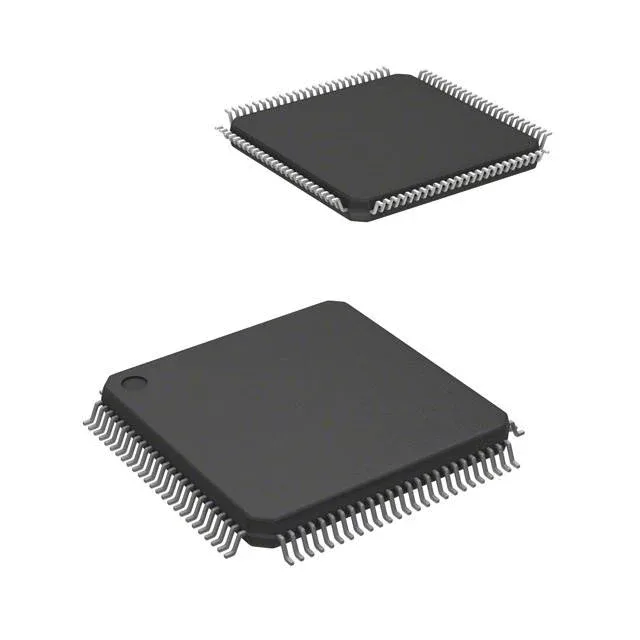
Texas Instruments has marked the LM3S1N11-IQC50-C1 as obsolete. For existing BOM lines, the part is sourced through independent distribution channels — quantities are lot-specific and confirmed at RFQ.
50 MHz Cortex-M3 — the performance floor
At this speed the core delivers roughly 62.5 Dhrystone MIPS — enough for a control loop with moderate sensor fusion or a protocol stack (Modbus RTU, CANopen) without a co-processor. The 64 KB on-chip flash and 12 KB SRAM set the firmware and data footprint ceiling. A typical UART bootloader plus a small RTOS kernel leaves about 40 KB for application code and 6 KB for runtime variables — adequate for a single-axis motor controller or a temperature-logging node, but tight for a GUI stack or large lookup tables. The industrial temperature range (-40 to 85°C) qualifies it for factory-floor enclosures, outdoor telecom cabinets, and engine-bay-adjacent electronics where the ambient stays below the 85°C ceiling.
Peripheral integration and I/O count
67 general-purpose I/O pins in a 100-LQFP package give the board designer room to connect parallel displays, keypads, and external memory buses without multiplexing. The peripheral set includes PWM, DMA, brown-out detect, POR, and a watchdog timer — enough on-chip resources to run a sensor hub or a brushless DC motor controller without external logic. Connectivity covers I2C, SPI, SSI, UART/USART, IrDA, LIN, and Microwire — a single part can bridge a CAN transceiver, an SPI flash, and an I2C temperature sensor. The 8-channel 10-bit ADC provides basic analog sampling for current-sense or thermistor inputs.
The exposed paddle (if present on this variant) should be soldered to a ground-plane thermal pad — the datasheet's recommended footprint and stencil aperture are the starting point for the PCB layout. Surface-mount assembly with a tray shipping medium — the tray orientation and moisture sensitivity level (MSL) must be confirmed before the reflow profile is set. A bake cycle at 125°C for 48 hours is standard if the floor life has been exceeded.