Texas Instruments lists the LM3S1N11-IBZ50-C1 as obsolete. This part is sourced through independent distribution channels — quantities are lot-specific and confirmed at RFQ. Availability and current pricing are quoted to order.
Cortex-M3 core at 50 MHz — firmware headroom
The ARM Cortex-M3 core runs at 50 MHz — this is the deterministic interrupt-handling workhorse for control-loop and protocol-stack tasks. The 64 KB on-chip flash and 12 KB SRAM are the firmware budget; the bootloader and HAL consume part of the flash before the application starts. Step through the boot ROM on first power-up to confirm the flash layout matches the linker script. The 32-bit single-core architecture with a single-cycle multiply and hardware divide handles 8/16/32-bit data efficiently for motor-control and sensor-fusion loops. Internal oscillator saves an external crystal on the BOM when the timing tolerance is acceptable for UART and I²C baud rates.
67 general-purpose I/O lines are multiplexed with the serial interfaces: I²C, IrDA, LINbus, Microwire, SPI, SSI, and UART/USART. The 8-channel 10-bit ADC samples analog inputs — the conversion clock and sample time must be configured per the datasheet timing to avoid aliasing on fast edges. On-chip peripherals include brown-out detect/reset, DMA, POR, PWM, and a watchdog timer. The DMA engine offloads peripheral-to-memory transfers without CPU intervention — useful for buffered serial streams or ADC scan sequences. The PWM module drives H-bridge or three-phase inverter stages directly.
108-BGA package — board integration
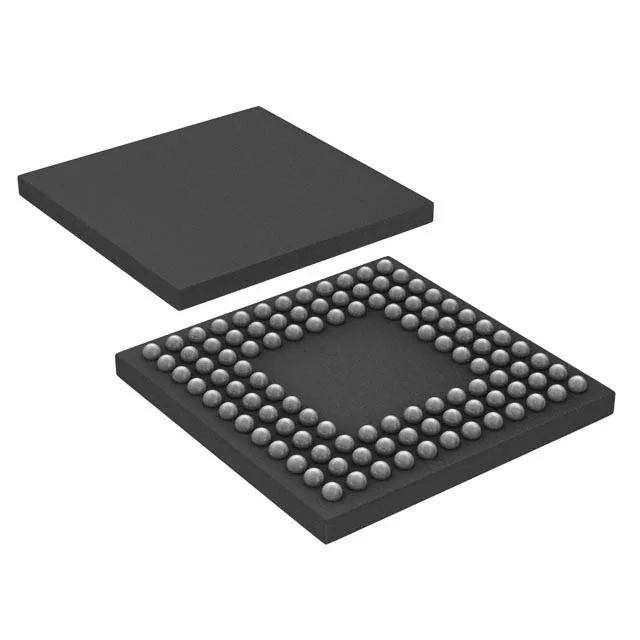
The 108-ball LFBGA with a 10x10 mm body requires a 4-layer PCB minimum for fan-out of the inner balls. The 0.80 mm ball pitch is standard for this density — the via-in-pad or microvia approach keeps the breakout clean. Surface-mount assembly with a standard reflow profile.