No last-time-buy window or successor order code is recorded in the lifecycle data. If a form-fit-function replacement is needed, the Stellaris family includes pin-compatible siblings with varying memory and peripheral sets — the LM3S1J15 is one such candidate, though its exact feature differences should be verified against the target application's requirements.
The 50 MHz ARM Cortex-M3 core delivers enough throughput for real-time control loops, Modbus or CAN gateway bridging, and sensor fusion algorithms without needing an external coprocessor. The 128 KB Flash can hold a FreeRTOS or TI-RTOS kernel plus application code for a medium-complexity product; the 20 KB SRAM supports several protocol buffers and a modest call stack. Designs that need more than 20 KB of RAM for data logging or display frame buffers will hit a ceiling — that is the constraint to check first when evaluating fit against a legacy BOM.
Peripheral set and package fit
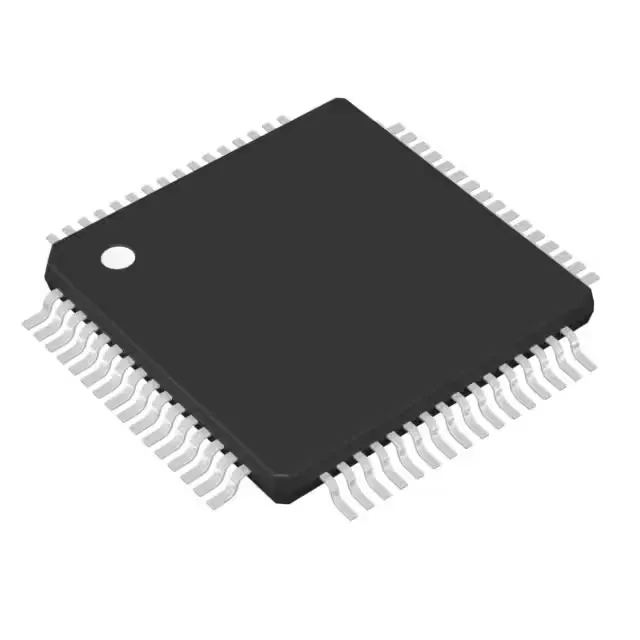
With I²C, SPI, UART, and LIN on the same die, this MCU can bridge multiple serial buses without external level shifters or protocol converters. The 8-channel 10-bit ADC covers analog inputs like potentiometers, thermistors, or current-sense resistors. Brown-out detect and POR eliminate the need for a dedicated supervisor IC in many designs. The 64-LQFP package with 0.5 mm pitch requires a standard PCB process — no micro-vias or blind vias needed. The 33 I/O lines are enough for a keypad matrix, a small character LCD, and a handful of discrete sensors and actuators.