50 MHz Cortex-M3 with 512 KB on-chip flash
The LM3S1H11-IQC50-A1T: The 32-bit Cortex-M3 core includes a hardware single-cycle multiply and a 3-stage pipeline with branch speculation, delivering 1.25 DMIPS/MHz. At 50 MHz the throughput ceiling is approximately 62.5 DMIPS, constrained by flash wait states at this clock rate.
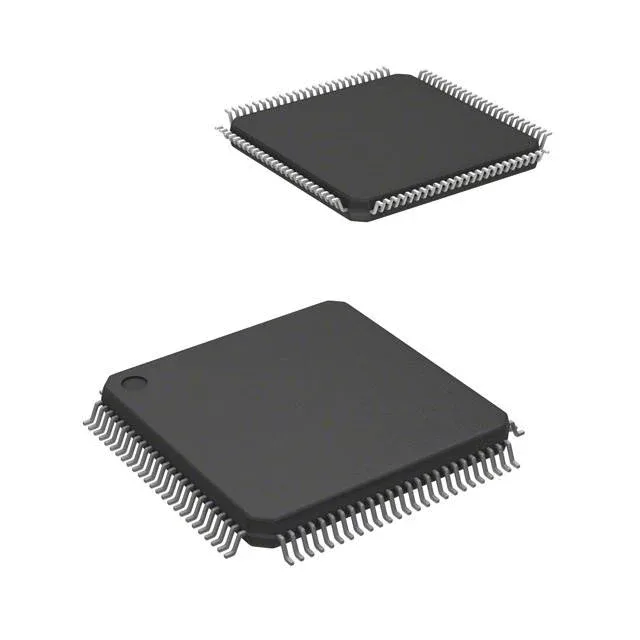
100-LQFP package and board integration
Housed in a 100-pin LQFP with a 14x14 mm body and 0.50 mm pitch, the LM3S1H11-IQC50-A1T demands a 4-layer PCB for reliable fan-out of the inner rows. The I/O ring runs from the same rail or a separate 3.3 V supply depending on the peripheral voltage tolerance — the datasheet's power sequencing guideline specifies that VDD must reach the operating range before any I/O pin is driven externally.
67 general-purpose I/O lines are multiplexed with a comprehensive peripheral set: EBI/EMI for external memory or FPGA interface, I²C, SPI, SSI, UART/USART, IrDA, LINbus, and Microwire. The EBI/EMI bus supports both synchronous and asynchronous devices with up to four chip selects, enabling direct connection to external SRAM, NOR flash, or an FPGA without glue logic. An 8-channel 12-bit successive-approximation ADC samples at up to 1 Msps. On-chip peripherals include a brown-out detect/reset circuit, a power-on-reset module, a DMA controller, a PWM generator, and a watchdog timer. The DMA engine offloads the CPU for memory-to-peripheral transfers — useful for moving ADC samples to SRAM without core intervention.
Texas Instruments has designated the LM3S1H11-IQC50-A1T as obsolete. No official successor or pin-compatible replacement is recorded from the original manufacturer. The Stellaris family was acquired by TI and later phased out; the Cortex-M4F-based TM4C series is the functional evolution but requires a board spin due to different pinout and peripheral map. Quantities are lot-specific and confirmed at RFQ. No last-time-buy window remains open from TI — procurement relies on existing inventory in the distribution channel.