80 MHz Cortex-M3 with 384 KB flash — what the memory split means for firmware
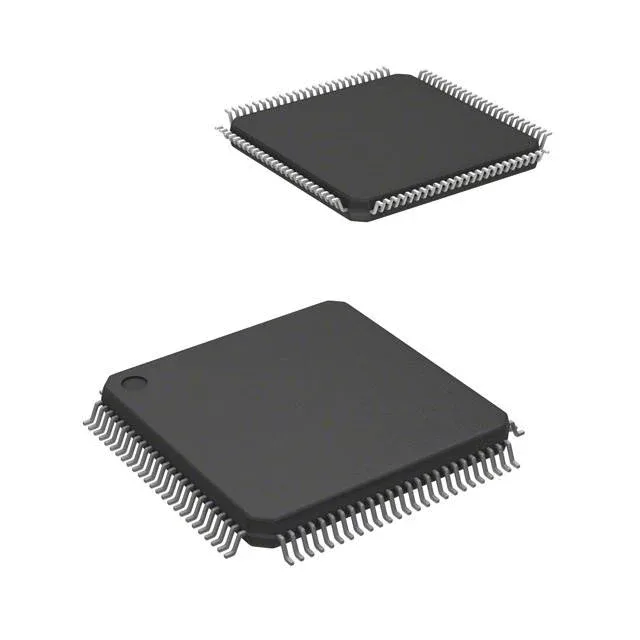
The LM3S1G21-IQC80-A1: That flash-to-RAM ratio — roughly 6:1 — suits applications where the firmware image is large but the runtime data set fits in a smaller buffer: think motor-control parameter tables, sensor-fusion coefficient sets, or communication protocol stacks that page through flash for the code and keep the active state in SRAM. The 80 MHz core clock is the processing ceiling for real-time control loops. At that speed a PID loop with 10 µs of computation leaves 90 µs of margin in a 100 µs cycle — enough for communication overhead and diagnostics without dropping into the interrupt scheduler.
100-LQFP board integration — pitch, fan-out, and rework considerations
The 100-LQFP package (14x14 mm body, 0.5 mm pitch) demands a 4-layer PCB for reliable fan-out of the inner rows. The 67 I/O lines include the EBI/EMI bus for external memory expansion — that bus alone consumes 20+ pins, so the remaining GPIO count for sensors and actuators is about 40, which is tight for a full HMI panel but adequate for a dedicated controller with a serial interface.
Texas Instruments has marked the LM3S1G21-IQC80-A1 as Obsolete. The Stellaris family was migrated to the Tiva C series, but the pinout and register map differ — a board spin is required for any direct replacement. Quantities are lot-specific and confirmed at RFQ. No stock-holding claim is made; each order is sourced against the BOM line with full traceability documentation.
Peripheral set — what the connectivity and analog blocks support
The LM3S1G21 integrates an 8-channel 12-bit ADC, a PWM module with dead-band insertion, and a DMA controller that can move data between peripherals and memory without CPU intervention. The connectivity block includes I²C, SPI, SSI, UART/USART, IrDA, LINbus, and Microwire — enough to talk to most industrial sensors, motor encoders, and fieldbus transceivers through a single serial bridge. The brown-out detect and POR circuits monitor the core supply. If the 1.3 V rail dips below the threshold, the MCU holds in reset until the supply recovers — this prevents flash corruption during power loss without an external supervisor IC.