80 MHz Cortex-M3 with 512 KB flash — what the memory budget buys
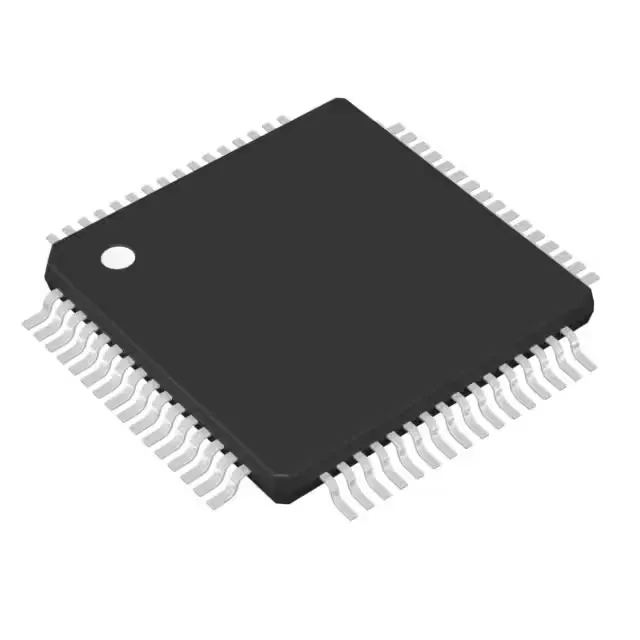
The LM3S1D26-IQR80-A2T: For a control-loop application running a real-time OS, the flash holds the kernel plus application image with room for field-update staging; the 96 KB SRAM buffers sensor data and communication stacks without external memory. The 12-bit ADC with eight multiplexed channels reads analog sensors directly — no external converter needed for basic current, voltage, or temperature monitoring. The on-chip DMA moves conversion results to SRAM without CPU intervention, keeping the 80 MHz core free for protocol handling.
Peripheral set and connectivity — what it connects to on a factory-floor node
Connectivity covers I²C, SPI, SSI, UART/USART, LIN, IrDA, and Microwire — enough to talk to a fieldbus PHY, an external EEPROM, a display module, and a serial sensor all on one chip. The LIN and IrDA support is less common at this price point; LIN suits automotive sub-networks, IrDA works for short-range optical data transfer in clean environments. The PWM module drives small motors or LED dimming directly; the WDT guards against firmware lockup in unattended equipment. The 33 general-purpose I/O lines in a 64-LQFP package give enough pins for a parallel LCD bus, a keypad matrix, and a few discrete I/O without expanding the footprint.
Package and supply — board integration constraints
The 64-LQFP package measures 10x10 mm with 0.5 mm pitch — a standard four-layer board with via-in-pad is not required; two-layer breakout is feasible for the outer rows, though inner rows need at least one signal layer. Industrial temperature range (-40°C to +85°C) means the part works in outdoor enclosures, unheated warehouses, and engine-bay-adjacent compartments without a heater. The internal oscillator eliminates the external crystal for basic clocking, though an external source is still an option for tighter accuracy.
Obsolete status — what it means for a BOM line
Texas Instruments has marked the LM3S1D26-IQR80-A2T as obsolete. The last-time-buy window has closed; no new factory orders are accepted. Sourcing is through independent distribution channels — surplus, broker inventory, and end-of-life stock. A pin-compatible replacement from the same Stellaris family may exist, but the exact fit depends on the target firmware and peripheral requirements — verify the BOM position against the original design files before committing.