Core architecture and memory — what fits on the BOM
The LM3S1B21-IQC80-C3T: That clock rate, combined with the single-cycle multiply and hardware divide of the Cortex-M3, gives it enough throughput for real-time control loops — motor commutation or sensor fusion — without needing an external DSP. On-chip memory: 256 KB of Flash and 96 KB of SRAM. The Flash is enough for a moderate application stack plus a bootloader; the 96 KB SRAM leaves room for multiple frame buffers or a real-time OS heap without external memory. The 8-channel 10-bit ADC samples analog inputs directly — no external ADC needed for basic sensor readback.
Package and board-fit — 100-LQFP
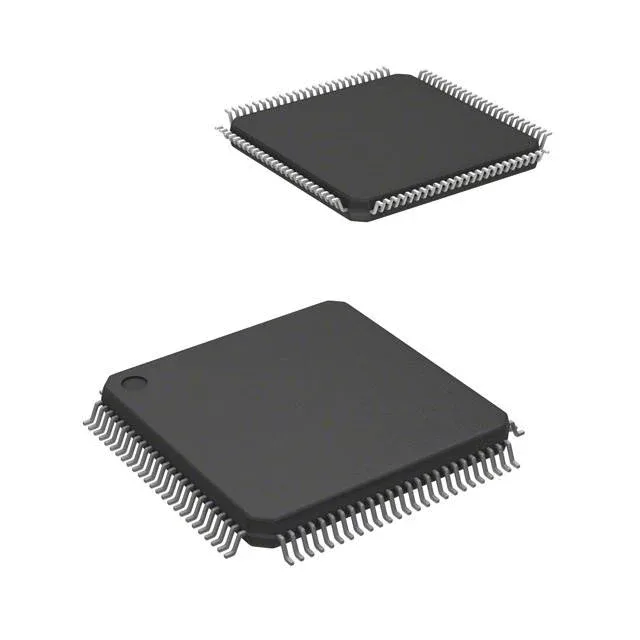
Housed in a 100-pin LQFP (14x14 mm body, 0.5 mm pitch). The 67 GPIOs break out across three sides, leaving the fourth for the power/ground ring. The 0.5 mm pitch demands a 4-layer board for clean fan-out — two-layer designs will struggle to route all signals without vias under the package. The internal oscillator eliminates the external crystal for most applications, though the EBI/EMI interface may need an external clock for synchronous memory.
Connectivity and peripherals — what the on-chip set covers
The connectivity block includes I²C, SPI, SSI, UART/USART, IrDA, LIN, and Microwire — enough to talk to most sensors, displays, and motor drives without external protocol converters. The EBI/EMI interface allows direct connection to external parallel SRAM or NOR Flash if the on-chip 256 KB is insufficient. On-chip peripherals: brown-out detect, POR, DMA, PWM, and a watchdog timer. The PWM channels can drive a three-phase inverter directly; the DMA offloads data movement from the CPU, keeping the 80 MHz core free for control math.
Lifecycle reality — obsolete, sourced to order
Texas Instruments has marked the LM3S1B21-IQC80-C3T as Obsolete. No stock-holding claim; each order is sourced per the BOM line.