Obsolete — sourcing the BOM line
Texas Instruments has marked the LM3S1B21-IBZ80-C3T as obsolete. The 80 MHz ARM Cortex-M3 core with 256 KB of on-chip flash and 96 KB of SRAM is the performance anchor for this BGA-packaged MCU. The 108-BGA (10x10 mm) footprint means a board spin is required for any alternative — there is no drop-in replacement.
80 MHz Cortex-M3 with 256 KB flash — what it means for fit
The 32-bit ARM Cortex-M3 core runs at 80 MHz — this is the throughput ceiling for control-loop and protocol-stack execution. The 256 KB flash stores the application binary; with a typical HAL + RTOS footprint of 40–60 KB, roughly 196–216 KB remains for application code, enough for a moderate industrial or sensor-fusion firmware load. The 96 KB SRAM serves as data and stack memory. For a TCP/IP stack with a 2 KB MTU buffer pool, the RAM budget leaves ~80 KB for application variables and DMA buffers — sufficient for most single-protocol embedded designs. This covers factory-floor enclosures, outdoor telecom cabinets, and engine-bay-adjacent applications without active cooling.
The MCU integrates EBI/EMI, I²C, IrDA, LINbus, Microwire, SPI, SSI, and UART/USART interfaces — enough for a mixed-protocol control board connecting to sensors, displays, and a fieldbus gateway. The 67 GPIOs handle parallel LCD buses, keypad matrices, and discrete I/O without external expanders. On-chip peripherals include brown-out detect, DMA, POR, PWM, and a watchdog timer. The 8-channel 10-bit ADC samples analog inputs for current-sense or potentiometer feedback without an external converter. The internal oscillator eliminates an external crystal for non-timing-critical applications.
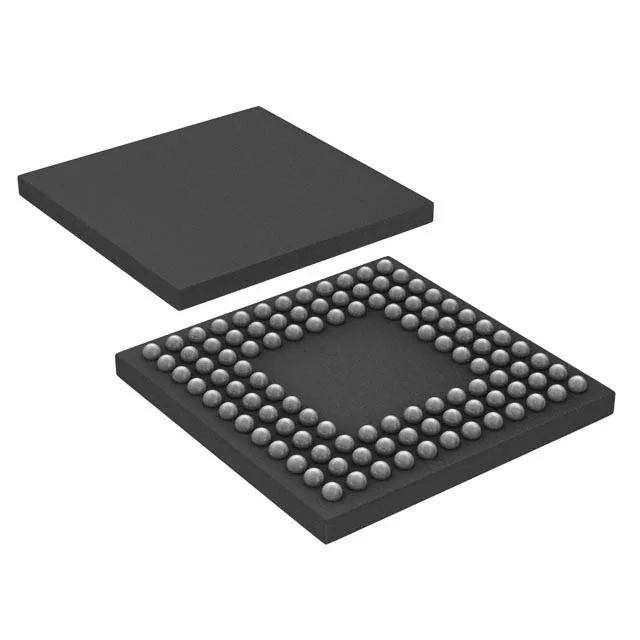
Housed in a 108-LFBGA (10x10 mm) package with surface-mount termination. The 0.80 mm ball pitch is standard for a 4-layer PCB fan-out — two-layer boards will struggle to route the inner balls. Tape and Reel packaging suits automated pick-and-place assembly.