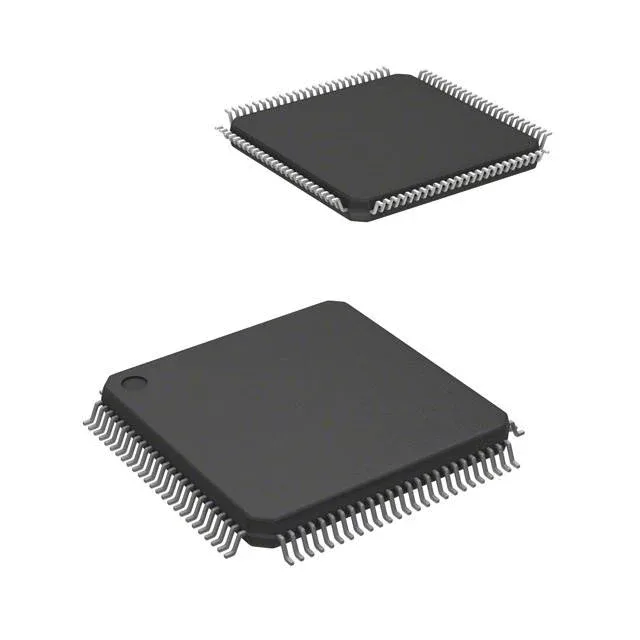
100-LQFP Cortex-M3 with 256 KB flash — the board-fit and memory budget
The LM3S1958-IQC50-A2T: The 0.5 mm pitch LQFP-100 demands a 4-layer PCB for full fan-out of the 52 general-purpose I/O lines. Supply voltage is a narrow 2.25 V to 2.75 V rail — a 2.5 V LDO with 200 mV dropout margin is the typical choice.
50 MHz Cortex-M3 — processing headroom and peripheral mix
The ARM Cortex-M3 core at 50 MHz delivers roughly 1.25 DMIPS/MHz, or about 62.5 DMIPS — enough for real-time control loops, protocol stacks, and moderate data processing without an external DSP. On-chip peripherals include an 8-channel 10-bit ADC, PWM outputs, a watchdog timer, and brown-out detect/reset with POR. The connectivity set covers I²C, SPI, SSI, UART/USART, IrDA, and Microwire — enough serial interfaces to handle a sensor hub, display, and fieldbus gateway on one die. The 256 KB flash and 64 KB SRAM budget leaves roughly 180 KB of code space and 48 KB of RAM after a typical RTOS and HAL footprint — adequate for a mid-complexity application like a motor controller with Ethernet bridge or a multi-protocol I/O module.
NRND — planning for the last-time-buy window
Texas Instruments lists the LM3S1958-IQC50-A2T as NRND (Not Recommended for New Designs). This means the part is still available for existing production but is not intended for new design starts — a last-time-buy (LTB) notice may be issued at any time. For sustainment programs already using this MCU, the NRND status means the BOM line should be reviewed for a migration path. No official pin-compatible successor is recorded in the TI Stellaris line — the closest functional replacement would require a board spin to a different package or family.