Core and memory — what the 50 MHz and 256 KB flash mean for a control-loop application
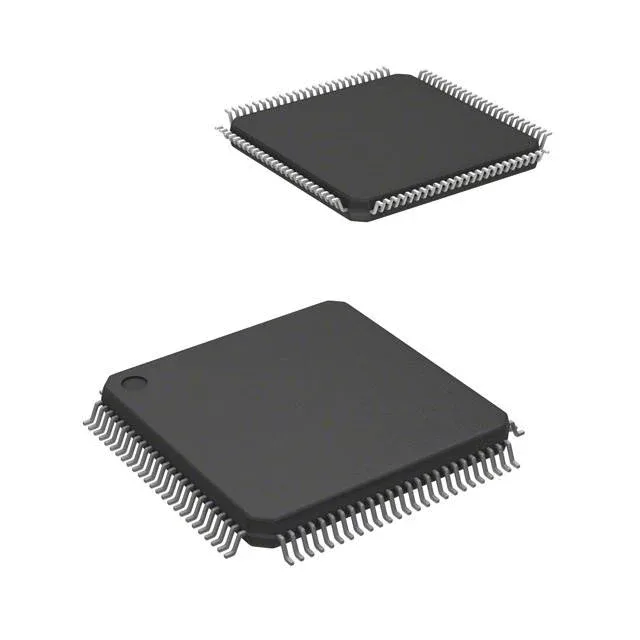
The LM3S1937-EQC50-A2: The 50 MHz ARM Cortex-M3 core delivers roughly 62.5 MIPS (1.25 DMIPS/MHz) — enough to run a sensor-fusion loop, a Modbus RTU stack, and a PID controller in a single tick without a scheduler fight. 256 KB of on-chip flash (256K x 8) and 64 KB SRAM (64K x 8) give the firmware engineer room for a full HAL, a real-time kernel, and a 10-15 KB data buffer before the memory map starts squeezing. The 2.25 V to 2.75 V supply rail means the part runs off a single 2.5 V LDO — a common intermediate rail in 3.3 V systems — but the core voltage is tight enough that a 2.5 V ±2 % regulator is safer than a 2.5 V ±5 % one.
Package and board-fit — 100-LQFP with a 14x14 mm body
100-LQFP (14x14 mm) with 0.50 mm pitch — the outer rows break out on a two-layer board, but the inner power/ground pins need at least a four-layer stack to keep the fan-out clean and the return paths short. Surface-mount only — no socket option. The 56 I/O lines fan out to the perimeter pads, so the decoupling cap placement under the body is blocked; plan for eight to ten 100 nF caps on the perimeter within 5 mm of the VDD/VSS pairs.
Industrial temperature grade — -40 to +105 °C
A motor-drive controller in a NEMA 4X enclosure on a hot factory floor stays within the envelope; an under-hood ECU at 110 °C ambient does not.