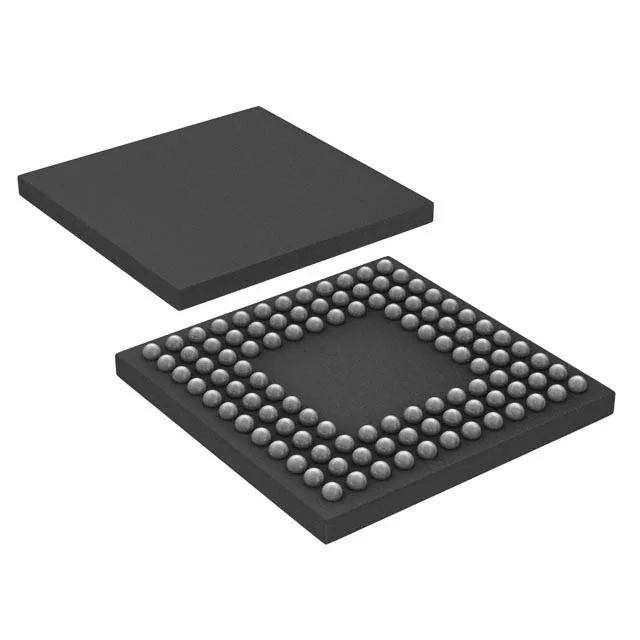
The LM3S1635-IBZ50-A2: For a BOM that already carries this order code, the NRND status does not force an immediate redesign, but it does mean the procurement team should lock in a qualified surplus channel.
50 MHz Cortex-M3 with 128 KB flash — memory headroom for a real RTOS
The ARM Cortex-M3 core runs at 50 MHz — enough throughput for a control loop with a moderate protocol stack. The 128 KB on-chip flash and 32 KB SRAM leave room for a FreeRTOS or ThreadX kernel plus the application heap, though a heavy TCP/IP stack with multiple sockets will push the SRAM budget. Program memory is flash, so firmware updates in the field are feasible — budget the sector erase time into the update window. The 56 general-purpose I/O lines cover a mixed sensor-and-actuator interface without an external GPIO expander.
108-ball BGA — board integration and rework realities
The 108-LFBGA package with a 10x10 mm body demands a controlled-impedance PCB stack-up and X-ray inspection after reflow. The 0.50 mm ball pitch is manageable with a 4-layer board; a 2-layer design will struggle to fan out the inner rows without blind vias. Surface-mount assembly is standard, but the BGA footprint means rework requires a hot-air station with a preheater — a soldering iron alone will not remove the part.
Peripheral set and supply rail
Connectivity includes I²C, SPI, SSI, UART/USART, IrDA, and Microwire — enough serial interfaces for a sensor hub or a bridge to a fieldbus gateway. The 4-channel 10-bit ADC handles analog inputs like potentiometers or current-sense resistors without an external converter. The internal oscillator eliminates an external crystal for non-critical timing, though a precision clock source is still needed for USB or CAN if those peripherals are used.