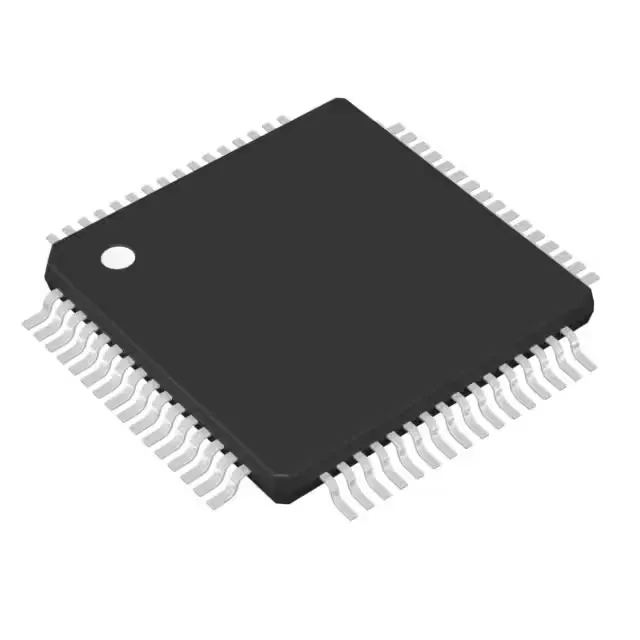
50 MHz Cortex-M3 with 128 KB Flash — mid-range control workhorse
The 33 GPIO lines in a 64-LQFP package give reasonable headroom for parallel LCD data buses or multiple encoder inputs.
Industrial temperature grade — factory-floor and outdoor telecom ready
The internal oscillator means one less external crystal to fail in vibration-heavy environments, though the accuracy will drift with temperature — if you need a precision timebase, plan to use an external clock source on the oscillator input.
Texas Instruments has not issued a last-time-buy notice as of the current record, but the NRND flag signals that this part is on a path toward eventual discontinuation. For a new design, you should evaluate a pin-compatible successor within the Stellaris family or a current-production Cortex-M3/M4 from TI's Tiva C Series. For an existing BOM that already qualifies this MCU, the NRND status means you can still source it through independent distribution on a quoted-to-order basis — but the window for last-time-buy procurement may open without much notice, so securing a lifetime buy or qualifying an alternate is worth planning now.
Supply rail note — 2.5 V nominal, not 3.3 V
If the rest of the board is 3.3 V logic, the GPIO pins are not 5 V tolerant and will need level translation for any 3.3 V peripheral. A dedicated 2.5 V LDO with at least 100 mA headroom is the straightforward fix — the LM3S1625's core draw plus I/O switching current typically stays under 80 mA at 50 MHz, so a 150 mA rated regulator like the TPS73625 handles it cleanly.