Cortex-M3 core at 25 MHz — what the clock buys you
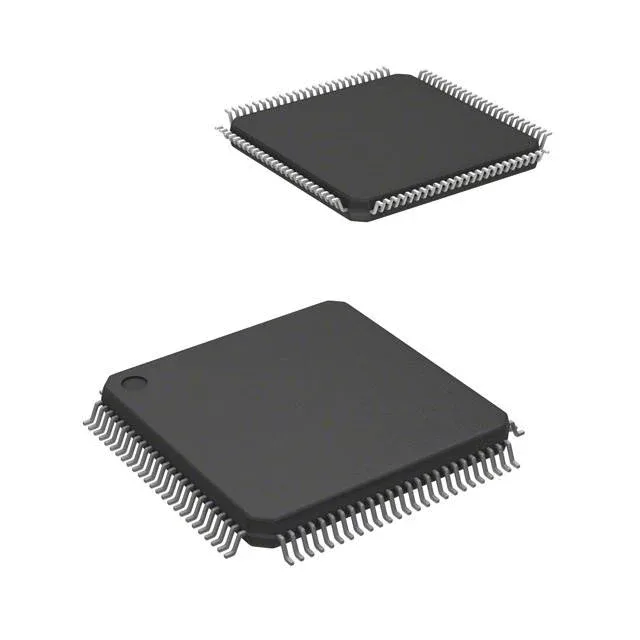
The LM3S1620-IQC25-A2T: The ARM Cortex-M3 core runs at 25 MHz, delivering around 25 DMIPS — enough for real-time control loops, sensor fusion, and protocol bridging without an RTOS overhead penalty. The internal oscillator trims the BOM by one external crystal, though an external clock source can still be fed in for tighter timing. 128 KB of on-chip flash and 32 KB of SRAM (32K x 8) leave room for a moderate application stack plus a small RTOS kernel. The flash is single-cycle at 25 MHz up to the zero-wait-state boundary — the exact boundary depends on the flash controller's prefetch buffer, so profile the actual instruction-fetch stalls in your tightest loop.
52 general-purpose I/O lines in a 100-pin LQFP give plenty of headroom for parallel buses, keypad matrices, and discrete sensor inputs. The connectivity block includes I²C, SPI, SSI, UART/USART, IrDA, Microwire, and a quadrature encoder interface (QEI) — the QEI is useful for motor-speed feedback without a dedicated timer capture. On-chip peripherals include brown-out detect, POR, PWM, and a watchdog timer — the brown-out reset monitors the 2.25 V to 2.75 V supply rail and asserts reset before the core logic enters an undefined state.
Temperature grade and environment
The 100-LQFP (14x14 mm) package has a typical junction-to-ambient thermal resistance around 40°C/W — the 2.75 V max supply keeps the power dissipation low enough that no heatsink is needed in still air.