What the NRND status means for your BOM line
Texas Instruments lists the LM3S1608-IQC50-A2T as NRND (Not Recommended for New Designs). This is not an immediate end-of-life — the part remains available for existing production runs, but TI will not qualify it into new designs. Any new BOM should target the successor or a pin-compatible alternative; existing designs can continue sourcing through independent distribution against an RFQ.
Core, memory, and speed — the fit decision
At its heart is an ARM Cortex-M3 core running at 50 MHz — a 32-bit single-core processor with 128 KB of on-chip Flash program memory and 32K x 8 SRAM. The 50 MHz clock is enough for moderate-throughput control loops, protocol stacks, and sensor fusion; the 128 KB Flash holds a FreeRTOS or bare-metal application with a TCP/IP stack, though a BLE or Wi-Fi profile will eat into that budget quickly. The 32K x 8 RAM (256 Kbit) is the tighter resource — a large frame buffer or multi-instance stack may force external SRAM or a part with more on-chip memory.
Temperature range and deployment environment
It is a fit for outdoor telecom cabinets, factory-floor controllers, and automotive cabin modules that see 85°C soak but not under-hood extremes. The 2.25 V to 2.75 V supply rail is a narrow 2.5 V nominal — the regulator feeding this rail must hold within 10 % across load steps, or the core browns out.
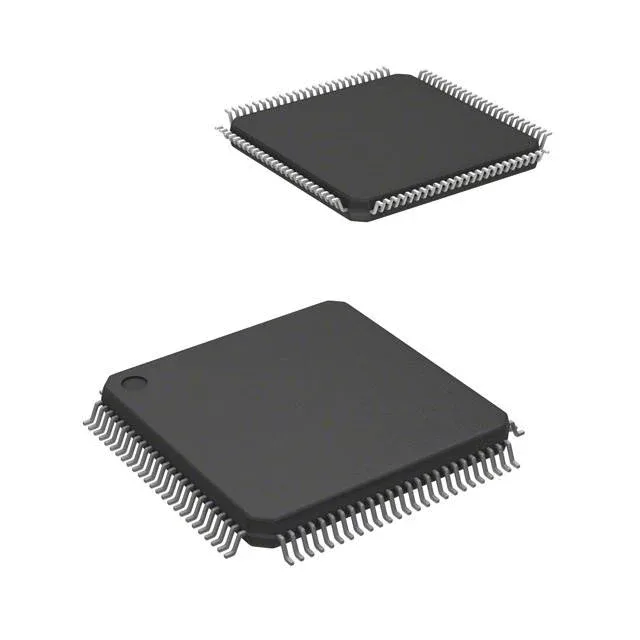
Housed in a 100-LQFP with a 14x14 mm body (supplier device package 100-LQFP 14x14). The 0.5 mm pitch fan-out is manageable on a 4-layer board; a 2-layer board routes the outer rows but the inner power/ground pins need vias to the internal planes. The 52 available I/O lines include an 8-channel 10-bit ADC — enough for a basic sensor front-end without an external converter.
Peripherals and connectivity
The peripheral set covers I²C, SPI, SSI, UART/USART, IrDA, and Microwire — the usual serial buses for industrial sensors, memory, and display modules. The internal oscillator eliminates an external crystal for the core clock, though an external 32.768 kHz crystal is still needed if the RTC or a low-power sleep timer is used. Brown-out detect, POR, PWM, and a watchdog timer round out the on-chip housekeeping.