50 MHz Cortex-M3 with 128 KB flash — what the memory budget means for firmware
The LM3S1608-IQC50-A2 is a Texas Instruments Stellaris ARM Cortex-M3S 1000 series MCU running at 50 MHz. The 128 KB on-chip flash and 32 KB SRAM set the firmware and runtime data limits — a moderate-sized application stack plus a real-time OS kernel leaves roughly 60–70 KB of flash for the application layer after the HAL and RTOS footprint, and about 16–20 KB of SRAM after the stack and heap reservations. The 2.25 V to 2.75 V supply rail is a narrow window — the regulator feeding this part must hold within 250 mV of the nominal 2.5 V setpoint across load transients, or the core browns out. The internal brown-out detect and POR peripherals monitor the rail and reset the core on a dip, but a clean local LDO with 50 mV dropout margin is the safer call for production boards.
100-LQFP package — rework and board integration
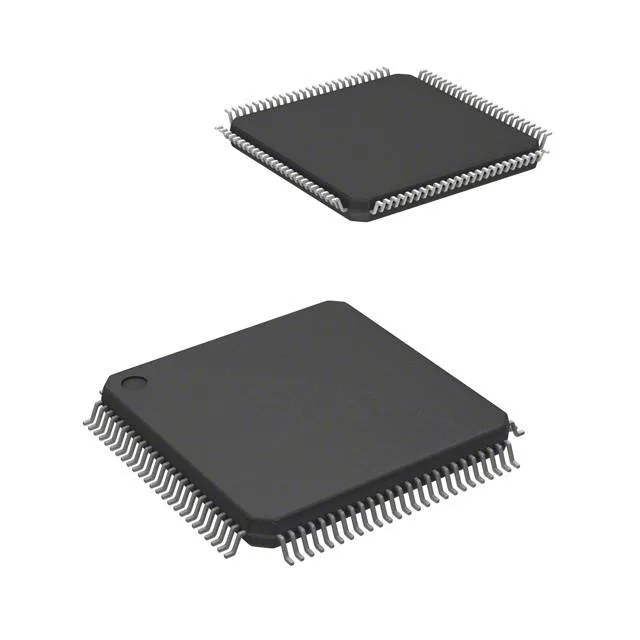
The 100-LQFP with a 14x14 mm body and 0.50 mm pitch demands a 4-layer board for reliable fan-out — the inner rows of the QFP need at least one signal layer and a ground plane to keep the return paths short. Without that, the junction temperature at 85 °C ambient and full I/O switching will exceed the 105 °C junction limit. Rework on a 100-pin QFP is straightforward with a hot-air station — the 0.50 mm pitch is fine enough that a misaligned part will short adjacent pins on reflow, so a stencil-alignment jig or optical inspection after placement is worth the setup time. The orientation mark is on pin 1 corner; the package body is notched on the same corner, so you can verify alignment under a loupe before the hot air hits it.
Peripheral set — connectivity and analog capture
The connectivity block includes I²C, SPI, SSI, UART/USART, and IrDA — enough for a sensor hub talking to an external ADC over SPI, a UART debug console, and an I²C temperature sensor on the same bus. The SSI port can drive a synchronous serial display or a daisy-chained shift-register bank for extra GPIOs. The 8-channel 10-bit ADC samples at up to 1 Msps typical — adequate for reading potentiometers, current-sense resistors, or thermistor dividers at control-loop rates. For higher resolution or faster sampling, an external 12-bit SPI ADC would be the add-on. 52 GPIOs cover moderate I/O needs — a keypad matrix, a few LED indicators, relay drivers, and encoder inputs fit within that count without needing a port expander.
Obsolete — sourcing reality for this Stellaris MCU
Texas Instruments has marked the LM3S1608-IQC50-A2 as Obsolete. The Stellaris family was acquired and later phased out as TI consolidated its ARM MCU portfolio under the Tiva and SimpleLink lines. There is no official pin-compatible drop-in replacement from TI — a board spin to a Tiva TM4C123 or a SimpleLink MSP432 would require a new PCB layout and firmware port. Quantities are lot-specific and confirmed at RFQ — no stock-holding claim, no lead-time number. The 100-LQFP package and the 2.5 V supply rail are the two non-negotiable constraints for any substitute candidate.