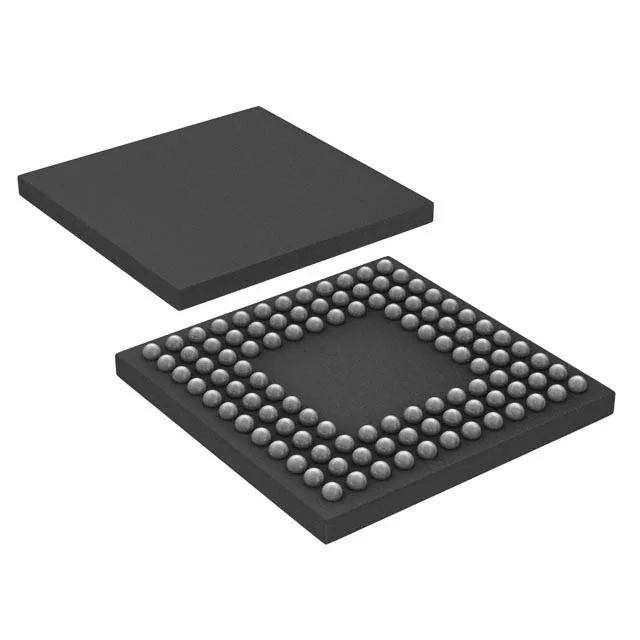
What the NRND status means for your BOM line
Texas Instruments lists the LM3S1608-IBZ50-A2T as NRND (Not Recommended for New Designs). This means the part is still available for existing production but is not intended for new design-ins — the manufacturer will not support new project starts with this order code. For a BOM that already carries this MCU, the NRND flag signals a finite procurement window. Stock is available through independent distribution; quantities and lead times are confirmed at RFQ.
50 MHz Cortex-M3 with 128 KB flash — throughput and memory headroom
The ARM Cortex-M3 core runs at 50 MHz — this is the instruction throughput ceiling for the application. The 128 KB on-chip flash (128K x 8) and 32 KB SRAM (32K x 8) provide enough code and data space for mid-complexity control firmware, sensor fusion, or protocol-stack execution without external memory. Flash program memory type means field firmware updates are possible over the UART or SPI bootloader, but the 100K erase/write cycle endurance per sector should be budgeted into the update strategy.
108-ball BGA — board integration and supply rails
Housed in a 108-LFBGA package with a 10x10 mm body (supplier device package 108-BGA 10x10), the part requires a multi-layer PCB for fan-out of the 0.50 mm pitch balls. The 52 available I/O route to peripherals and external interfaces.
Peripheral set — connectivity and analog interface
Connectivity options include I²C, IrDA, Microwire, SPI, SSI, and UART/USART — enough serial interfaces to handle sensor buses, display modules, and debug links without an external UART bridge. On-chip peripherals include brown-out detect/reset, POR, PWM, and a watchdog timer — these supervisory blocks reduce external component count for power sequencing and fault recovery. An 8-channel 10-bit ADC handles analog inputs like potentiometers, current shunts, or temperature sensors directly.