Cortex-M3 core at 50 MHz — what the speed buys you
The LM3S1608-IBZ50-A2 runs an ARM Cortex-M3 core at 50 MHz — this is the processing ceiling for the interrupt-driven control loops typical in motor-drive or sensor-fusion firmware. The 32-bit single-core architecture delivers deterministic context switching; the NVIC handles up to 32 interrupt vectors with a fixed 12-cycle entry latency, so the core can service a fast sensor edge without polling overhead. On-chip memory is 128 KB of flash for program store and 32 KB of SRAM for data. That flash footprint accommodates a moderate HAL plus a real-time operating system kernel and leaves room for application logic; the 32 KB SRAM supports a few kilobytes of stack and heap per task before hitting the ceiling. A firmware developer targeting this part should budget the SRAM for the interrupt stack and DMA buffers first.
Connectivity spans I²C, SPI, SSI, UART/USART, and IrDA — enough to talk to external ADCs, serial flash, or a fieldbus transceiver without an external UART bridge. The 52 GPIOs are general-purpose but share pads with the serial peripherals; a layout that routes out all four UARTs and two SPI buses consumes roughly half the available pins, leaving two dozen for discrete I/O. The on-chip ADC is 8-channel, 10-bit — adequate for reading potentiometers, current-sense resistors, or temperature sensors at moderate update rates.
Package, supply, and temperature grade
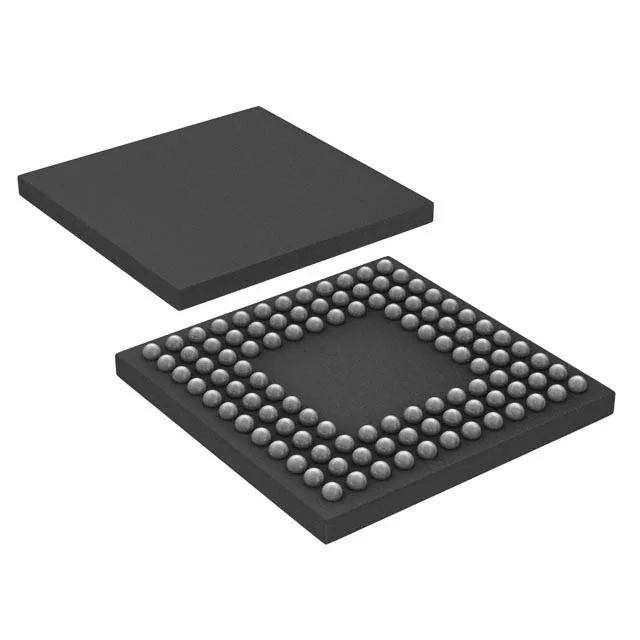
Housed in a 108-ball BGA (10x10 mm body), the part requires a multi-layer PCB for fan-out — the 0.80 mm ball pitch does not route on a two-layer board without blind vias. The internal oscillator starts up without an external crystal, though a crystal on the main oscillator input improves accuracy for time-sensitive serial protocols.